
Chicago Deed Records
Chicago deed records are maintained by the Cook County Clerk's Office - Recordings Division, which has handled all property document recording for Cook County since December 7, 2020, when it absorbed the former Cook County Recorder of Deeds. Residents and researchers can search deed records online by Parcel Identification Number, grantor name, or grantee name through the Cook County Clerk's recordings search portal, or visit the office in person at 118 N. Clark Street in Chicago.
Chicago at a Glance
- City: Chicago
- County: Cook County
- Population: 2,711,226
- County Recorder: Cook County Clerk's Office - Recordings Division
- Address: 118 N. Clark Street, Room 120, Chicago, IL 60602
- Phone: (312) 603-5050
- Hours: Monday-Friday, 9:00 AM - 5:00 PM (last customer 4:45 PM)
Where Chicago Deed Records Are Filed
All property deed records for Chicago are recorded at the Cook County Clerk's Recordings Division. This office is located at 118 N. Clark Street, Room 120, Chicago, IL 60602. The phone number is (312) 603-5050. Staff are available Monday through Friday from 9:00 AM to 5:00 PM, with the last customer accepted at 4:45 PM.
The Cook County Clerk took over all recording duties on December 7, 2020. Before that date, the separate Cook County Recorder of Deeds handled these records. The merger moved all functions to the Clerk's office. All prior records are still accessible and were not lost in the transition.
You can reach the recordings help desk by email at recording.helpdesk@cookcountyclerkil.gov. Staff can answer questions about document status, search procedures, and what is needed to submit a document for recording.
The Cook County Clerk's Office - Recordings Division website is the starting point for most searches and submissions:
Visit https://www.cookcountyclerkil.gov/recordings for full service information.
The image below shows the Cook County Clerk Recordings Division page, where you can find links to search deed records, submit documents, and set up fraud alerts for Chicago properties.
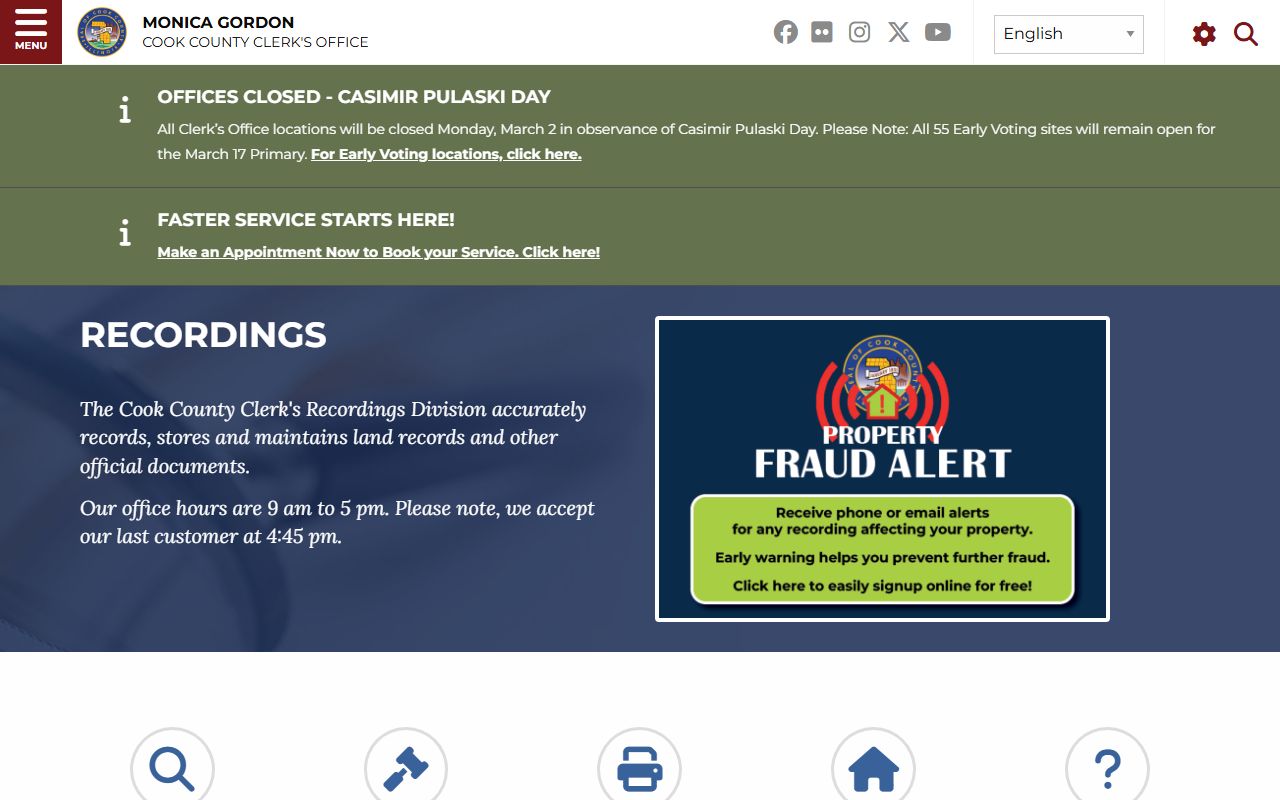
This page gives access to all recording services. From here you can search by PIN, grantor, or grantee. You can also find information on fees, eRecording, and the Property Fraud Alert program.
How to Search Chicago Deed Records Online
The Cook County Clerk offers a free online search tool at https://www.cookcountyclerkil.gov/recordings/search-recordings. You can search by Parcel Identification Number (PIN), grantor name, grantee name, or document number. Results show the document type, recording date, and parties involved.
The search portal shown below lets you look up deeds, mortgages, liens, and other recorded instruments for any Chicago address.
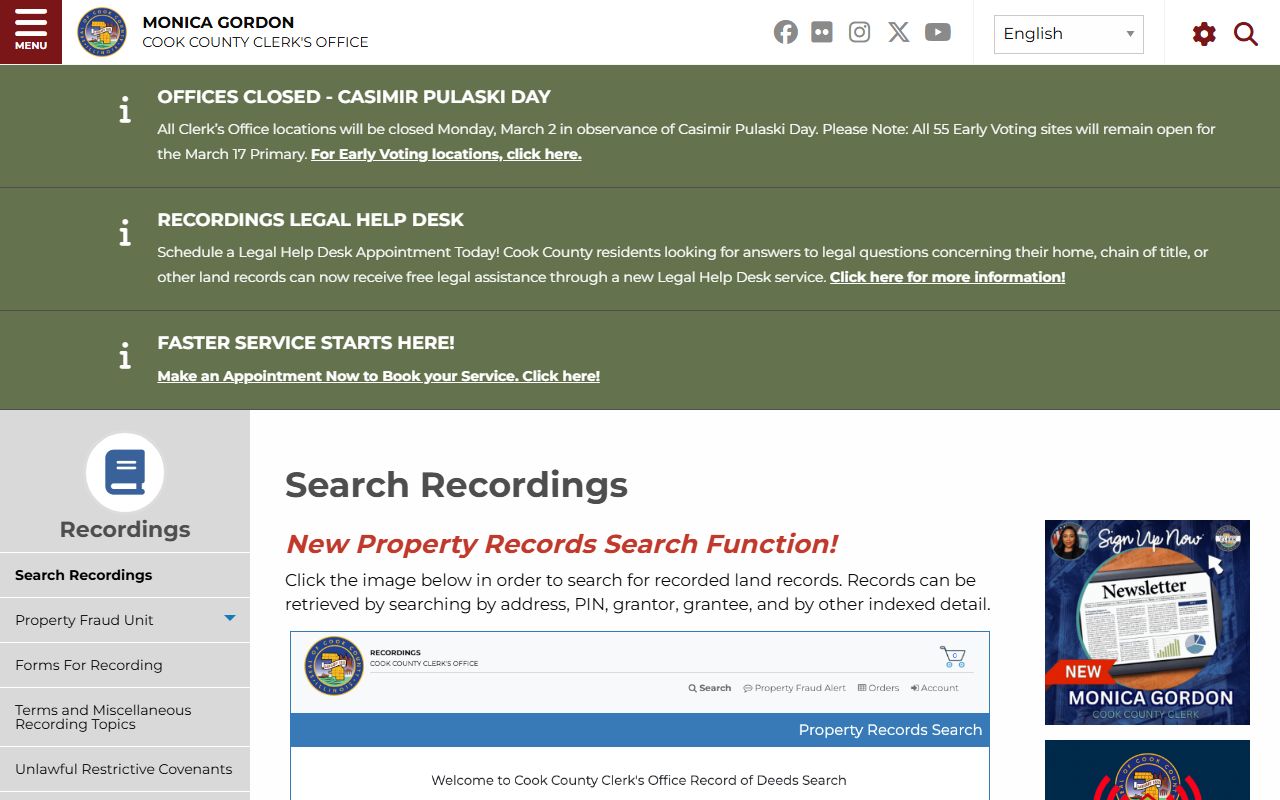
The search tool is available at no cost. You can view basic record information for free. If you need a certified copy of a deed, you must order it through the Clerk's office. Certified copies can now be ordered as e-certified documents, which can be downloaded and are legally valid.
To search by address, you first need the PIN for the property. The Cook County Assessor's website can help you look up the PIN for any Chicago address. Once you have the PIN, enter it into the Clerk's search tool to pull up all recorded documents for that parcel.
The grantor and grantee search lets you look up records by the names of the parties on the deed. This is useful if you do not have a PIN. You can narrow results by document type and date range.
Recording Documents in Chicago
You can record a deed or other property document in three ways: in person at the Clark Street office, by mail, or through eRecording. ERecording is available through approved vendors including Simplifile, CSC, EPN, Hopdox, and Indecomm. Most title companies and real estate attorneys use eRecording for speed and convenience.
Standard recording fees range from $27.50 to $107 depending on the document type and number of pages. Non-standard documents may cost between $2 and $142. Documents that do not meet standard formatting requirements incur additional fees. Always confirm the current fee before submitting.
A document is considered "standard" if it meets specific size, margin, and font requirements set by state law under 765 ILCS 5. If a document does not meet those requirements, the non-standard fee applies on top of the base recording fee.
Starting January 1, 2026, there are no recording fees for documents that modify a restrictive covenant. This change came from a new state law and applies across all of Cook County, including Chicago.
Chicago Real Estate Transfer Tax
Chicago is one of the few Illinois cities that levies its own real estate transfer tax on top of the state and county taxes. When you sell or transfer property in Chicago, you must pay three separate transfer taxes.
The state transfer tax is $0.50 per $500 of the sale price. The county transfer tax is $0.25 per $500. Chicago's city transfer tax is an additional amount collected at the time of sale. The city tax is separate from the county and state taxes and must be paid to the City of Chicago before a deed can be recorded.
Before a deed can be recorded in Chicago, you must submit a MyDec declaration through the Illinois Department of Revenue's online system. MyDec is available at https://mytax.illinois.gov/MyDec/. This system handles the state Real Estate Transfer Tax Declaration, also known as the PTAX-203 form. You must complete MyDec and get a declaration stamp or approval before taking the deed to the Clerk's office.
The PTAX-203 instructions can be found at https://tax.illinois.gov/localgovernments/property/general-information/ptax-203_instructions.html. Review these instructions before filling out the form. The form asks for sale price, property type, and other details about the transaction.
There is also a Residential High Speed Program (RHSP) surcharge of $18 per document. This fee applies to most deed recordings and helps fund affordable housing programs in Illinois.
Property Fraud Alert for Chicago Property Owners
The Cook County Clerk offers a free Property Fraud Alert service at https://www.cookcountyclerkil.gov/recordings/property-fraud-unit. When you sign up, you get an email or text alert any time a document is recorded against your property. This is a good way to catch deed fraud early.
Deed fraud happens when someone records a fake deed to transfer your property without your knowledge. It is a growing problem in large cities. Chicago property owners are encouraged to enroll in this free alert system. Sign up takes only a few minutes and requires your name and property PIN.
If you receive an alert for a recording you did not authorize, contact the Property Fraud Unit right away. The Clerk's office has a dedicated unit to investigate these cases and work with property owners and law enforcement.
Legal Resources for Chicago Property Owners
The Cook County Clerk's Recordings Division offers a free Legal Help Desk for questions about recording documents. This service is available by appointment and by email. It is not legal advice in the traditional sense, but staff can explain procedures and what is needed to record a specific document.
Illinois Legal Aid Online has a detailed guide to filing documents at the county recorder's office at https://www.illinoislegalaid.org/legal-information/filing-documents-county-recorders-office. This resource covers what types of documents can be recorded, how to prepare them, and what to expect when you submit them.
Under 55 ILCS 5/3-5018, county clerks in Illinois are required to record documents presented to them that meet the statutory requirements. This law sets the baseline for what must be accepted for recording in Cook County.
Veterans who need to record a DD-214 discharge document can often do so for free. Contact the Recordings Division to confirm the current policy for military discharge records.
Types of Deed Records Filed in Chicago
The Cook County Clerk's Recordings Division handles many types of documents beyond just deeds. Common document types include warranty deeds, quitclaim deeds, trustee's deeds, and special warranty deeds. The office also records mortgages, releases of mortgage, liens, easements, plats of subdivision, and UCC filings.
A warranty deed transfers ownership and guarantees clear title. A quitclaim deed transfers whatever interest the grantor has without any title guarantee. Quitclaim deeds are common in family transfers and estate situations. A trustee's deed is used when a trust holds title to property and the trustee is conveying it to a buyer.
Mechanics liens, judgment liens, and federal tax liens can also be recorded and searched through the Clerk's system. These types of liens affect the title to a property and show up in a title search. Buyers and lenders check for these before closing on a transaction.
The 765 ILCS 33 statute governs electronic recording in Illinois. It allows counties to accept documents submitted electronically, which is now the most common method used by real estate professionals in Chicago.
In-Person Access to Chicago Deed Records
You can visit the Recordings Division at 118 N. Clark Street, Room 120, Chicago, IL 60602 to search records in person. The office has public terminals where you can look up documents. Staff can help you with searches if you are not familiar with the system.
Bring the property address or PIN when you visit. If you want a certified copy, request it at the counter. Staff will print and certify the document while you wait or tell you when it will be ready. Fees for certified copies vary by document type.
The office is in the Cook County Building, which is accessible by the Chicago Transit Authority. The Brown, Purple, Red, Blue, and Pink lines all stop at stops near the building. Metered parking is available in the area but can be hard to find. Public transit is often the easier option.
Nearby Cities
Other Cook County cities with deed records filed at the Cook County Clerk's Recordings Division: