
Search Illinois Deed Records
Illinois deed records are public documents held at the county level by the County Recorder of Deeds or County Clerk. There is no single state office for deed records in Illinois. Each of the 102 counties runs its own land record system. You can search Illinois deed records online through county portals, request copies in person, or use the state's MyDec system to look up property transfer declarations. This guide explains where to find deed records in Illinois, what they contain, and how to access them.
Illinois Deed Records Quick Facts
How Illinois Deed Records Work
In Illinois, deed records are kept at the county level. There is no central state office where all deed records are stored. Each county has its own Recorder of Deeds (or County Clerk in smaller counties) who records, indexes, and stores land documents. If you need a deed record in Illinois, you go to the county where the property sits. The county recorder is the official keeper of that record.
Under 765 ILCS 5/, the Conveyances Act, deeds in Illinois must be in writing and signed by the grantor. The law says a deed should be recorded in the county where the real estate sits. Once recorded, it puts future buyers and creditors on legal notice. Section 5/30 states that unrecorded deeds are void against subsequent creditors and purchasers without notice. Recording protects your ownership rights in Illinois.
Deed records include more than just the deed itself. County recorders in Illinois also keep mortgages, mortgage releases, liens, judgments, plat maps, easements, and Uniform Commercial Code (UCC) filings. In smaller counties, the County Clerk handles recording duties. The range of documents and years of available records vary by county across Illinois.
Search Illinois Deed Records Online
Many Illinois counties offer free online deed record searches. Each county runs its own system, so you search each one separately. Cook County uses its own portal. Many other counties use platforms like Fidlar AvaWeb, Tapestry, or Laredo. To search deed records online in Illinois, you typically need the property's PIN (Parcel Identification Number), the grantor or grantee name, or the document number.
The state of Illinois also runs the MyDec system, which lets you look up Real Estate Transfer Declarations (PTAX-203 forms). MyDec is a free service of the Illinois Department of Revenue. You do not need to log in to search existing declarations. To find a declaration, you need the county plus the exact PIN, document number, or property address. The system times out after 30 minutes of inactivity, so have your information ready before you start. MyDec is at mytax.illinois.gov/MyDec.
The Illinois MyDec portal also handles Cook County and City of Chicago Real Estate Transfer Declarations. Law firms, settlement agencies, and title companies use MyDec to file transfer declarations online. The system lets users track and correct declarations during the recording process. Not all counties use MyDec, so check the participating agencies list before you start a filing. The list is at mytax.illinois.gov/MyDec.
The Illinois Department of Revenue maintains MyDec and supports the filing process across participating counties.
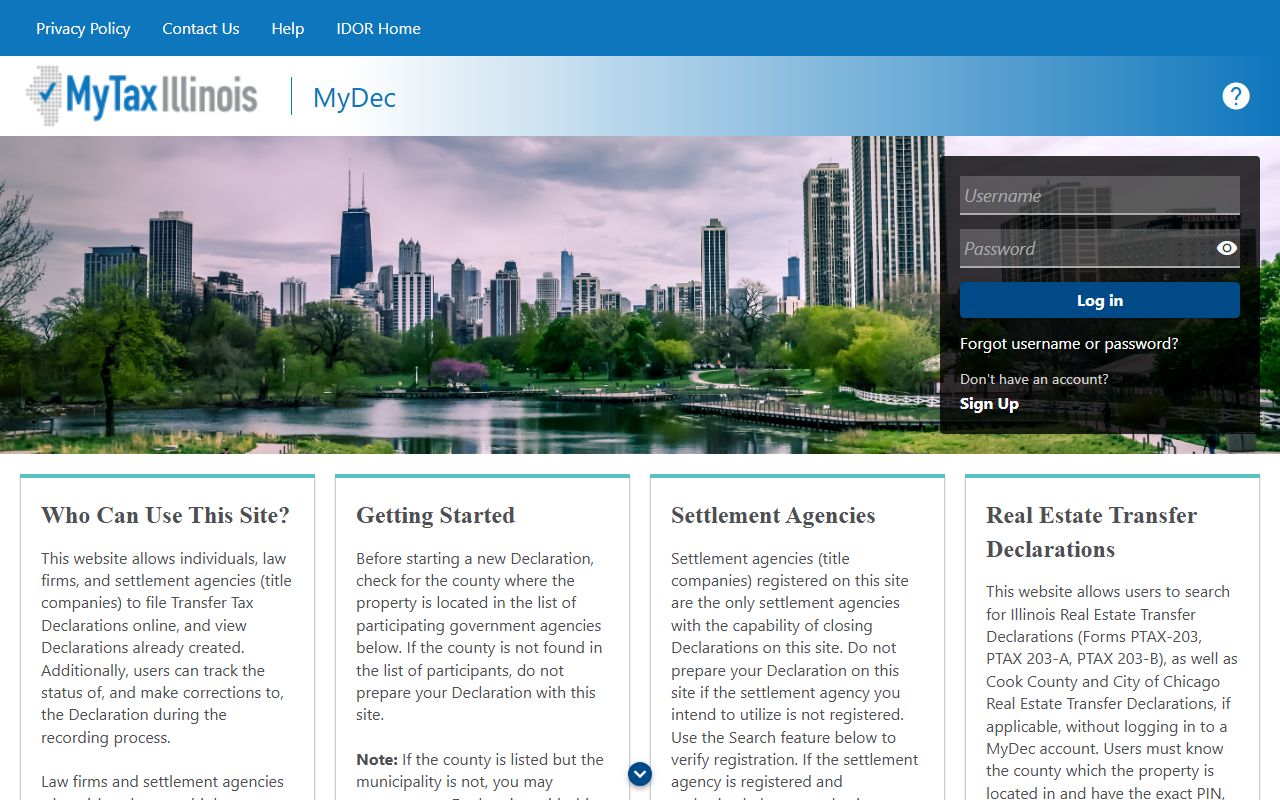
The MyDec portal lets individuals, law firms, and settlement agencies file Transfer Tax Declarations and search declarations already on record for Illinois deed transactions.
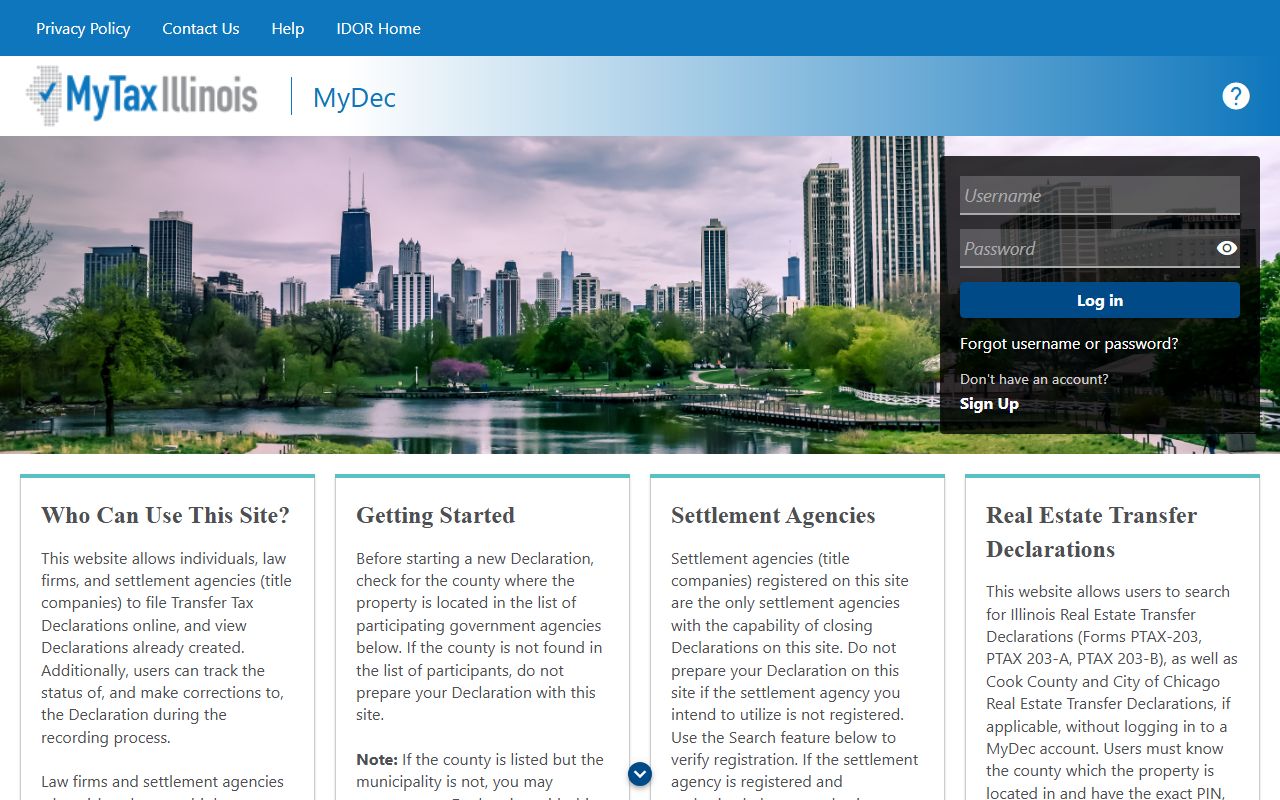
Note: MyDec searches require the exact PIN, document number, or property address to pull up a declaration.
Illinois Real Estate Transfer Declarations
When you record a deed in Illinois, you typically must file a Real Estate Transfer Declaration (Form PTAX-203). This form is required by the Real Estate Transfer Tax Law at 35 ILCS 200/31-1 et seq. The state charges a transfer tax of $0.50 per $500 of value. Counties add their own transfer tax of $0.25 per $500 of value. You file the PTAX-203 at the same time you record the deed with the county recorder in Illinois.
Some transfers are exempt from this requirement. Exempt transfers include deeds where the actual consideration is less than $100, deeds to government bodies or charities, deeds that correct or supplement a prior deed, deeds that release property held as security for a debt, deeds made as part of a bankruptcy or merger, and tax deeds. There are 12 exemption categories in total. Anyone who willfully falsifies information on Form PTAX-203 is guilty of a Class B misdemeanor for the first offense. Later offenses rise to a Class A misdemeanor. Full instructions are at tax.illinois.gov.
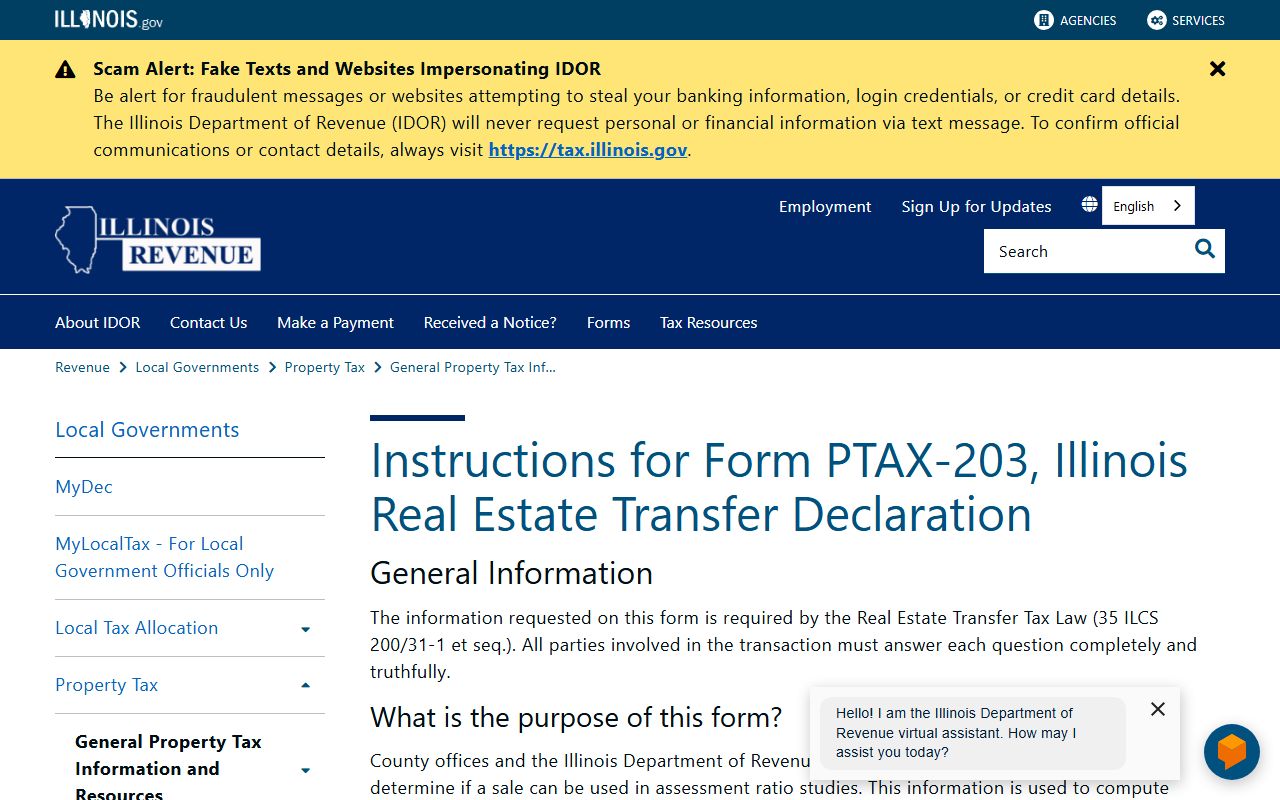
County offices and the Illinois Department of Revenue use the PTAX-203 to collect sales data and to set property assessment ratios. If unsure whether your transfer qualifies for an exemption, call the Illinois Department of Revenue at 217-782-4568.
Recording a Deed in Illinois
Illinois county recorders accept deed filings three ways: in person at the county courthouse, by mail, and through electronic recording (eRecording). In-person recording is the most direct. You bring the original document and payment to the recorder's office during business hours. Staff check the document against state statutory requirements. If it passes, they stamp it with an assigned number and date, index it, scan it, and mail the original back to you. Most offices return originals within two to five business days.
Mail submissions work the same way. You send the original document with payment to the recorder's office. Many counties accept checks or money orders. If the document is missing required information, it is returned rather than recorded. A document is recorded only when all required information is present and fees are paid. The original is then mailed back to the name and address on the document.
Electronic recording is common in Illinois. Under 765 ILCS 33/, the Uniform Real Property Electronic Recording Act, county recorders may receive, index, store, and transmit electronic documents. Standards are set by the Illinois Electronic Recording Commission. Major counties like Cook, DuPage, Lake, Will, and Kane all accept eRecording. Most use vendors such as Simplifile, CSC (Corporation Service Company), and EPN (eRecording Partners Network). Not all document types can be eRecorded. Plats and military discharge records (DD-214s) are generally not accepted electronically.
Electronic documents must be placed in the same index as paper documents, so your deed record is searchable through the same system regardless of how it was submitted.
Illinois Deed Recording Fees
Recording fees vary across Illinois's 102 counties. State law sets the fee framework under 55 ILCS 5/3-5018, which sets out what county recorders may charge. Fees include base recording fees, GIS surcharges, automation fees, and document storage fees. There is also a Rental Housing Support Program (RHSP) surcharge of $18 per document on most recordings in Illinois.
In Cook County, standard document recording costs range from $27.50 to $107. Non-standard documents run from $2 to $142. DuPage County charges $79 for standard documents as of January 1, 2025, and $99 for non-standard ones. Plats of subdivision cost $109 in DuPage County. Copies typically cost $1 per page in most counties. Certified copies cost more than plain copies. Contact the specific county recorder for current fees, as they set their own schedules within state limits.
Note: As of January 1, 2026, county recorders in Illinois cannot charge fees for filing a restrictive covenant modification to remove an unlawful restrictive covenant from a recorded deed.
What a Deed Must Include in Illinois
A deed in Illinois must meet certain standards before a county recorder will accept it. Under 765 ILCS 5/35c, the names of the grantor and grantee must be typed or printed clearly. The deed must include the grantee's address for tax purposes, the name and address of the person to receive the document after recording, and the preparer's name and address. All real estate documents must show the Permanent Parcel Number (PIN). Without these elements, the recorder will return the deed to you.
The Conveyances Act at 765 ILCS 5/ sets out the basic forms for general warranty deeds and quitclaim deeds. A general warranty deed uses the words "conveys and warrants" and gives the buyer the strongest title protection. A quitclaim deed uses "convey and quit claim" and transfers only what the grantor actually owns. Both types are common for deed transfers in Illinois. The county recorder's office does not provide deed forms and cannot help fill them out. A legal professional should prepare the deed.
Historical Illinois Deed Records
The Illinois State Archives maintains the Public Domain Land Tract Sales Database. This indexes over 550,000 names of original land owners from records of the U.S. General Land Office, the Illinois Central Railroad, and Illinois state officials. Records run from 1814 to 1925. You can search by the purchaser's name or by a legal description of the land. The database is at ilsos.gov.
Some Illinois county deed records go back to the early 1800s. Madison County records start in 1812. Kane County records go back to 1837. LaSalle County has records from the early 1830s, though some were lost in an 1880 courthouse fire. Older records may only be accessible in person at the county recorder's office or on microfilm. Computerized records in most counties start in the 1970s to 1990s. When county records are lost to fire or other causes, the Destroyed Public Records Act at 765 ILCS 45/ provides procedures for re-recording documents from certified copies or other jurisdictions.
The Raymond H. Hammes Collection at the Illinois State Archives contains early land and historical records from Kaskaskia in Randolph County, making it a strong resource for genealogists tracing Illinois property history.
Legal Help for Illinois Deed Records
The recorder's office cannot give you legal advice. Staff can tell you whether a document meets recording requirements, but they cannot explain the legal effect of a deed or help fill out forms. If you have questions about recording a deed or about what a recorded document means, contact an attorney or a legal aid service.
Illinois Legal Aid Online offers general information about filing documents with county recorders in Illinois. Their resource at illinoislegalaid.org explains what recorders do, how to file, and what to expect. There is also a free Recordings Legal Help Desk run by the Cook County Clerk's Office. Cook County residents can contact the help desk at recording.helpdesk@cookcountyil.gov or by calling (312) 603-5050. They assist with questions about home ownership, chain of title, and other land record issues at no charge.
Property fraud is a concern in larger counties. Cook County, Will County, and others offer free Property Fraud Alert programs. You sign up to receive a notice if anyone files a document against your property. Cook County's Property Fraud Unit is part of the Clerk's Office and can be reached at cookcountyclerkil.gov. Several other counties use the PropertyFraudAlert.com service, which is also free.
Browse Illinois Deed Records by County
Illinois deed records are held at the county level. Select a county below to find the local recorder's office, search options, fees, and recording information specific to that area.
View All 87 Illinois Counties →
Illinois Deed Records by City
Most Illinois cities rely on the county recorder in their area for deed records. Find local recording information for major cities below.