
Search Bureau County Deed Records
Bureau County deed records document every transfer of real property in the county and are filed with the Bureau County Clerk and Recorder in Princeton, Illinois. The recorder's office keeps an index of all deeds, mortgages, plats, easements, and related land instruments going back to the county's founding, and you can search that index by party name, parcel identification number, or legal description. In-person searches, mail requests, and any available online access are all options for getting the information you need from the recorder's office.
Bureau County at a Glance
- County Seat: Princeton
- Population: 32,866
- Office: Bureau County Clerk & Recorder
- Address: 700 S. Main St., Princeton, IL 61356
- Phone: (815) 875-2014
- Hours: Monday-Friday, 8:00 AM - 4:30 PM
Searching Deed Records in Bureau County
The Bureau County Clerk and Recorder maintains all land records for the county. Warranty deeds, quitclaim deeds, trustee's deeds, mortgages, releases of mortgage, assignments, easements, and plats are all part of the recorder's collection. Each document is assigned a document number when accepted, and it is indexed under the grantor's name, the grantee's name, and the parcel identification number.
If you want to search by address, you first need to find the parcel identification number that corresponds to that address. The county assessor or GIS office can help with PIN lookups. Once you have the PIN, the recorder's staff can show you all instruments tied to that parcel. This is the most reliable way to get a complete chain of title for a specific piece of property in Bureau County.
Walk-in access is available during regular office hours. Staff can assist you in navigating the index, though they are not permitted to provide legal advice or interpret documents for you. If you need a copy of a recorded deed, plain copies and certified copies are available. Call (815) 875-2014 to confirm the current fee schedule before you visit or send a request by mail.
Requirements for Recording Deeds in Illinois
Every deed recorded in Bureau County must comply with Illinois recording requirements. Under 765 ILCS 5, a deed must be signed by the grantor, acknowledged before a notary public, and contain a legal description of the property being conveyed. Missing any of these elements means the recorder's office must reject the document and return it to you.
The parcel identification number is required on every deed. The first page must have a blank space of at least three inches by five inches in the upper right corner, reserved for the recorder's stamp. Do not put any text or markings in that area. Documents must be on white paper, letter size, with black ink and legible print throughout.
The PTAX-203 Real Estate Transfer Declaration is required for most property transfers in Illinois. The Illinois Department of Revenue publishes the form and its instructions at tax.illinois.gov. This declaration captures the sale price and other details that determine how much transfer tax is owed. Certain exempt transfers still require the form to be completed with an exemption code. Review the instructions carefully to determine whether your transaction qualifies for an exemption.
Transfer taxes apply at both the state and county level. The state rate is $0.50 per $500 of consideration, and the county adds $0.25 per $500. These taxes are typically paid at the time of recording. The Rental Housing Support Program surcharge of $18 is collected on most recorded instruments statewide and goes to fund affordable housing programs.
The PTAX-203 and Illinois Transfer Tax Rules
The PTAX-203 is the state's standard form for reporting a real property transfer. It must be completed before a deed can be recorded unless the transaction is exempt from transfer tax. Even exempt transfers require the form with an exemption code. You can submit the form using the Illinois Department of Revenue's MyDec online system at mytax.illinois.gov/MyDec, or you can use the paper form.
The instructions for the PTAX-203 cover a wide range of transfer types, including standard sales, transfers to trusts, foreclosure sales, and exchanges. Read the instructions closely because the form asks specific questions about the nature of the transaction, and getting those answers right affects the transfer tax amount. Title companies and attorneys routinely handle this form as part of the closing process.
Below is a screenshot of the Illinois Department of Revenue page where PTAX-203 instructions are published. This page is the official source for the form and its requirements.
Source: Illinois Department of Revenue - PTAX-203 Instructions
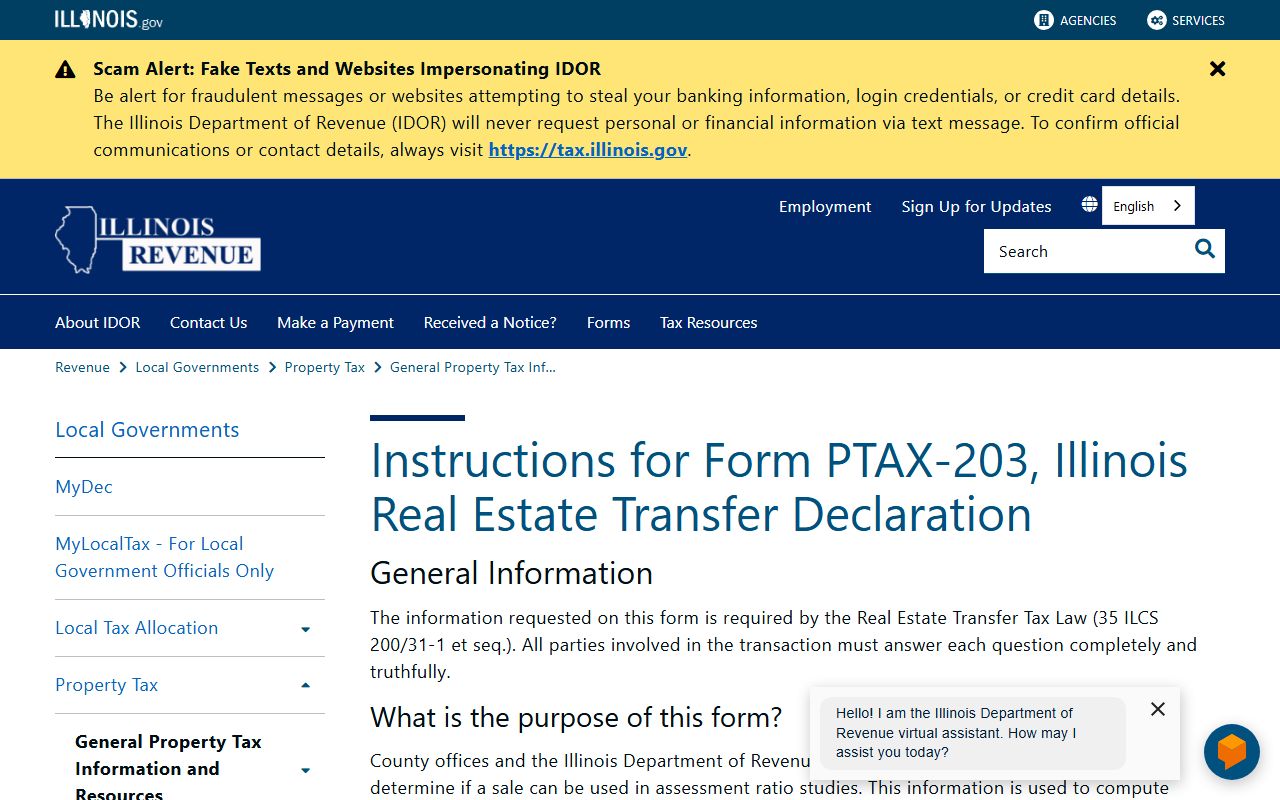
Use the PTAX-203 instructions to determine which exemptions apply and how to calculate the transfer tax due before recording a deed in Bureau County.
Real Property Tax Law and Deed Transfers
Illinois real estate transfer taxes are governed primarily by 35 ILCS 200, the Property Tax Code. This statute covers the entire framework of property taxation in Illinois, including how assessments are made, how appeals work, and how transfer taxes are calculated and collected. Understanding the Property Tax Code matters when you record a deed because it tells you how the new owner's tax obligations begin and how the county treasurer gets notified of the ownership change.
When a deed is recorded, the recorder transmits the transfer information to the county assessor, who updates the ownership record for the parcel. The next tax bill will then go to the new owner. If you buy property and do not record the deed promptly, you risk not getting tax bills in your name, which can lead to late payments and penalties. Recording promptly protects your interests.
Below is a screenshot of the page on Justia's legal database that displays 35 ILCS 200, the Illinois Property Tax Code. This is a useful reference for understanding transfer tax rules and property assessment procedures that affect deed recording in Bureau County.
Source: Justia - 35 ILCS 200 Illinois Property Tax Code
The Property Tax Code is the legal framework behind transfer taxes and ownership updates that follow deed recording in Bureau County and across Illinois.
Electronic Recording Options
Illinois authorized electronic recording of land records through 765 ILCS 33, and many Illinois counties now accept eRecording. If Bureau County participates, you can submit deeds and other instruments electronically through approved platforms such as Simplifile, CSC eRecording, EPN, Hopdox, or Indecomm. Call the recorder's office at (815) 875-2014 to confirm current eRecording availability and which platforms are accepted.
eRecording is convenient for title companies and attorneys who need to record documents quickly without sending a courier or waiting for mail. For individual users recording a single deed, the office counter remains the most straightforward option. If you mail documents to the recorder, include the correct fees and a self-addressed stamped envelope for return of the original after recording.
County Recorder Duties Under Illinois Law
The Bureau County Recorder's duties are defined in 55 ILCS 5/3-5018. The statute requires the recorder to accept all instruments that meet legal requirements, index them promptly, maintain the records permanently, and make them available to the public. The recorder also sets fees within the limits the statute allows and must post those fees publicly. If the office refuses to record a document, it must state the reason in writing and return the instrument.
Getting Copies and Requesting Records by Mail
Plain copies of recorded deeds in Bureau County cost a per-page fee. Certified copies cost more and may be needed for estate proceedings, court filings, or title insurance purposes. To request copies by mail, write to the Bureau County Clerk and Recorder at 700 S. Main St., Princeton, IL 61356. Include as much detail as you have about the document, such as the names of the parties, the recording date, or the document number. Enclose a check or money order for the estimated fee and a return envelope.
If you are uncertain about the fee, call (815) 875-2014 before sending your request. Staff can quote you the applicable charges and advise whether plain or certified copies are more appropriate for your purpose. Title abstractors who regularly search Bureau County records may also be able to provide copies more quickly than a mail-in request allows.
Free Legal Help for Property Owners
Illinois Legal Aid Online provides free guidance on deed recording and related property matters. Their resource page at illinoislegalaid.org explains how to file documents with the county recorder, what documents the recorder accepts, and what to do if your document is rejected. If you need help with a deed transfer and cannot afford an attorney, Prairie State Legal Services serves Bureau County and may be able to assist qualifying individuals.
Military veterans in Bureau County can record their DD-214 discharge papers with the recorder at no charge in most cases. Once recorded, the document is preserved permanently and can be retrieved by the veteran or authorized family members. Call the office to ask about the DD-214 recording procedure and any access restrictions that apply.
Nearby Counties
Each neighboring county maintains its own deed records through its clerk and recorder office. Use the links below to access deed record information for counties near Bureau County.