
Clark County Deed Records Search
Clark County deed records are maintained by the Clark County Clerk and Recorder in Marshall and document all real property transactions filed in the county. This page covers how to record a deed, what Illinois law requires, what fees apply, and how to search or request copies of recorded instruments.
Clark County at a Glance
- County Seat: Marshall, IL 62441
- Population: 15,266
- Office: Clark County Clerk & Recorder
- Address: 501 Archer Ave., Marshall, IL 62441
- Phone: (217) 826-8311
- Hours: Monday-Friday, 8:00 AM - 4:30 PM
Recording Authority in Clark County
The Clark County Clerk and Recorder's office at 501 Archer Ave. in Marshall is where all real property instruments are filed. The clerk reviews each document for compliance with state standards, assigns a document number, stamps the filing date and time, and adds it to the public index. That index is organized by grantor and grantee names, making it possible to trace who sold or bought property in the county at any point in its recorded history.
Illinois deed law under 765 ILCS 5 sets the baseline requirements every deed must meet. Documents must be signed and notarized, include the property index number (PIN), show the grantee's mailing address and the preparer's information, and have a clear 3-by-5-inch space in the upper right corner of the first page for the recording stamp. These requirements are firm. Any document that falls short on one of them will be returned unfiled.
The PTAX-203 form is required for most property transfers and must be filed with the deed. The Illinois Department of Revenue provides instructions for completing the form at tax.illinois.gov.
The screenshot below shows the Department of Revenue instructions page, which explains each section of the PTAX-203 and how the transfer tax is calculated for Clark County recordings.
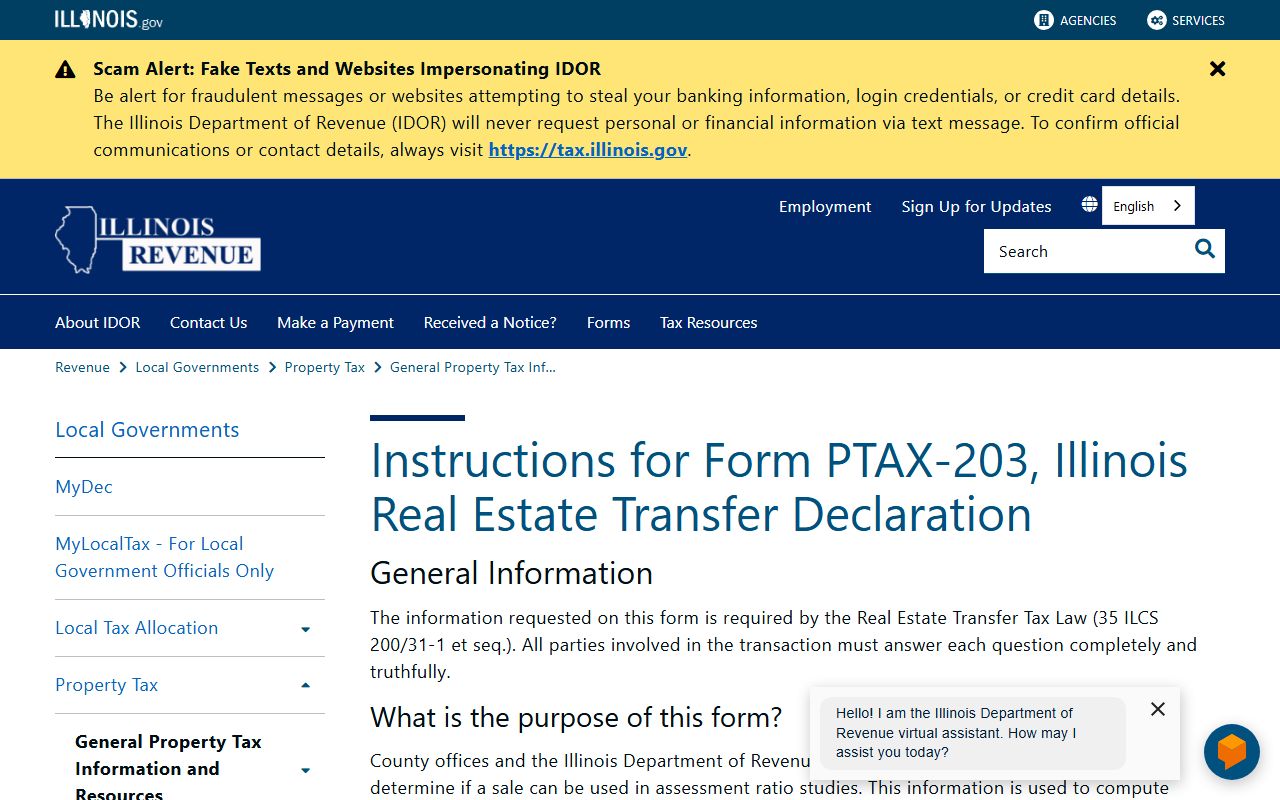
The PTAX-203 captures the sale price or consideration, identifies both parties, and describes the property. Even exempt transfers must include the form with the correct exemption box checked.
Fees for Recording a Deed
Clark County's recording fees follow the state schedule in 55 ILCS 5/3-5018. The standard fee covers the first page of a document plus a per-page charge for each additional page. The Rental Housing Support Program (RHSP) surcharge of $18 applies per document on top of the base recording fee. Confirm the current per-page amounts with the office before you come in, since the county board can update fees.
Real estate transfer taxes are also due at recording. The state rate under 35 ILCS 200 is $0.50 per $500 of consideration. Clark County adds $0.25 per $500. On a property selling at $80,000, the state tax is $80 and the county's share is $40. Add the base recording fee and the RHSP surcharge, and the total at the window for a standard residential deed typically runs over $150. The clerk collects all amounts at the time of filing.
Veterans recording a DD-214 military discharge certificate pay no fee. That exemption is statewide and honored at every Illinois county recorder office, including Clark County.
Searching Clark County Property Records
The Clark County Clerk and Recorder's office in Marshall is the primary place to search deed records. Staff maintain the grantor-grantee index and can help locate documents by name, PIN, or document number. Most searches are done at the public terminal in the office. Older records may need staff assistance or may only be available on microfilm or in hand-written ledger books.
Clark County was formed in 1819. Early deed records from the nineteenth century are on file in ledger form or on microfilm. The Illinois Regional Archives Depository (IRAD) at Eastern Illinois University in Charleston holds historical records from the east-central Illinois region, including Clark County. If you are researching old land transactions or doing title work on parcels with long histories, IRAD is worth checking before visiting Marshall.
Call (217) 826-8311 before your visit to confirm current hours and to ask whether any online access option is available. Some county clerk offices in Illinois have added web-based index search in recent years, and it is worth asking whether that is active in Clark County before you make the drive to Marshall.
MyDec and the PTAX-203 Process
The Illinois Department of Revenue operates the MyDec portal at mytax.illinois.gov/MyDec for online completion of the PTAX-203 transfer declaration. Using MyDec before you go to the courthouse can cut down on time at the window. The clerk can verify the declaration is already in the system and process the deed without waiting for a paper form to be reviewed.
MyDec guides you through a series of questions about the transaction to determine whether a transfer tax applies and whether an exemption might cover your situation. If the transfer qualifies for an exemption, you enter the correct exemption code and MyDec generates a confirmation that goes with the deed. If the transfer is taxable, MyDec calculates the amount owed so there are no surprises at the recorder's window.
Gift transfers, transfers to or from a revocable living trust, and certain family conveyances may qualify for exemption from the transfer tax. Check MyDec before the closing date so you know what documents to bring. If you are unsure whether your situation qualifies, the Illinois Department of Revenue property tax line can answer questions before you file.
Electronic Recording
Illinois authorized eRecording under 765 ILCS 33, the Uniform Real Property Electronic Recording Act. This law lets counties accept documents submitted through approved vendors. Ask the Clark County Clerk and Recorder whether eRecording is currently active and which platforms are authorized.
The screenshot below shows the 765 ILCS 33 statute page, which is the legal authority enabling eRecording in Illinois counties including Clark.
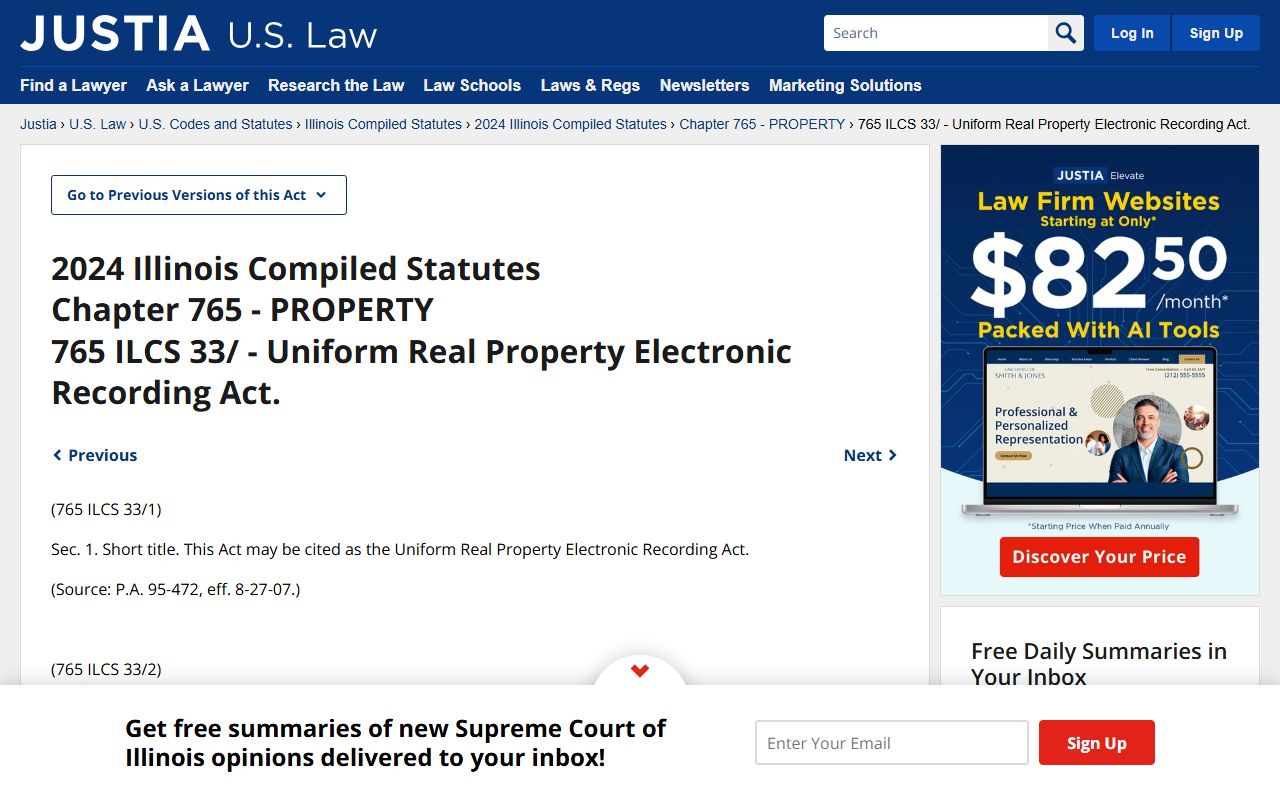
If eRecording is active in Clark County, title companies and lenders can use Simplifile, CSC, EPN, Hopdox, or Indecomm to submit documents digitally, pay fees, and receive recorded copies without going to the courthouse in Marshall. The legal effect is the same as a paper filing.
Document Format Requirements
Every document filed in Clark County must meet the physical standards in 765 ILCS 5. Paper must be white and sized between 8.5 by 11 inches and 8.5 by 14 inches. Text must be at least 10-point and clearly legible, with margins of at least half an inch. The upper right corner of the first page needs an unprinted 3-by-5-inch block for the recording stamp.
Signatures must be original and notarized. Photocopied signatures are not accepted. The notary's stamp must include the commission expiration date. Exhibits attached to a deed must follow the same paper and margin standards as the main document. Anything that does not meet these rules will be returned with a note explaining the specific problem.
Requesting Copies of Recorded Deeds
Certified copies of Clark County deed records are available from the clerk's office in Marshall. A certified copy includes the clerk's seal, confirms the document is a true copy of the recorded original, and is accepted for most legal purposes. Plain copies are available for less and work fine for reference or verification.
Mail requests should be sent to the Clark County Clerk and Recorder, 501 Archer Ave., Marshall, IL 62441. Include a check or money order for the copy fee, a self-addressed stamped envelope, and as much information as you can about the document you need: document number, recording date, grantor and grantee names, and the property address or PIN. Call (217) 826-8311 for the current copy fee rate before sending payment.
For legal help with deed problems in Clark County, Illinois Legal Aid at illinoislegalaid.org provides plain-language guides on recorder office procedures. For disputes involving title, ownership, or liens that require legal advice, contact a licensed Illinois real estate attorney in the area.
Nearby Counties
These counties border Clark County and maintain their own deed records offices.