
Search Hancock County Deed Records
Hancock County deed records are filed at the Hancock County Clerk and Recorder's office at 500 Main St. in Carthage, Illinois, where every deed, mortgage, lien, and property instrument recorded in the county is indexed and stored for public access. To search existing records or file a new deed in Hancock County, the Carthage office at (217) 357-3911 is the place to start.
Hancock County at a Glance
- County Seat: Carthage, IL 62321
- Population: 17,281
- Office: Hancock County Clerk & Recorder
- Address: 500 Main St., Carthage, IL 62321
- Phone: (217) 357-3911
- Hours: Monday-Friday, 8:00 AM - 4:30 PM
Hancock County Clerk and Recorder
The Hancock County Clerk and Recorder is at 500 Main St. in Carthage. Phone is (217) 357-3911. Office hours are Monday through Friday. The Clerk and Recorder functions are combined in one office, so the same staff in Carthage handles both county administrative work and the complete deed and land records archive for all of Hancock County.
Each deed that arrives at the 500 Main St. counter gets stamped with the recording date and assigned a document number. The grantor's name and the grantee's name both go into the public index on the same day. That index is the foundation of property title research in Hancock County. It is free to search in person during regular office hours in Carthage.
The Hancock County deed archive is not limited to simple property transfers. The office records warranty deeds, quitclaim deeds, trustee's deeds, mortgages and their discharges, mechanic's liens, judgment liens, easements, plat maps, land contract memoranda, UCC filings tied to real property, and DD-214 military discharge documents. Each type of instrument gets a document number and an entry in the grantor-grantee index at 500 Main St.
The Illinois Department of Revenue's PTAX-203 instructions page, shown below from tax.illinois.gov, covers how the real estate transfer declaration form works and which transactions trigger the requirement when recording deeds in Hancock County.
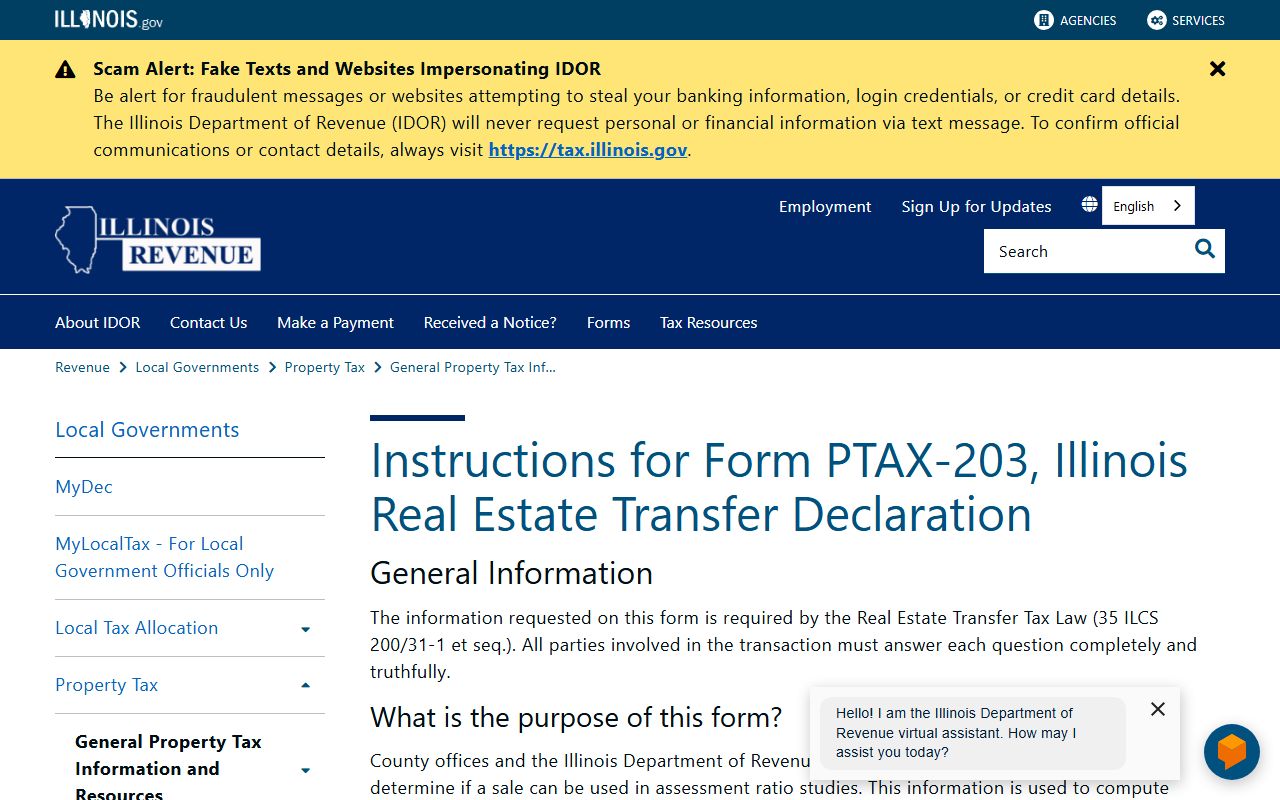
The PTAX-203 form is now submitted online through the state's MyDec portal before you come to the Carthage office. The system produces a barcode confirmation that you print and bring with the deed. The Recorder in Carthage scans that confirmation as part of accepting the instrument for recording.
Recording a Deed in Hancock County
Illinois deed recording requirements fall under the Conveyances Act at 765 ILCS 5. The statute applies across the state, including Hancock County. A deed must name both the grantor and the grantee clearly. It needs a complete legal description of the property being conveyed. The grantor's signature must be acknowledged before a notary.
Hancock County deeds must include the parcel identification number. The PIN ties the recorded instrument to the correct parcel in the county assessor's database. Write it near the legal description or at the top of the first page. The assessor's office in Carthage can confirm the correct PIN if you are unsure before you show up at 500 Main St.
Leave a blank 3-inch by 5-inch space in the upper right corner of the first page. Nothing can be in that space. The Recorder's staff use it for the official stamp that captures the recording date, document number, and instrument type. Any text, notary seal, or decorative element in that corner will get the document sent back without being recorded in Hancock County.
Most taxable real estate sales in Hancock County require the PTAX-203 to accompany the deed at the counter. Exempt transfers still need a completed form with the exemption noted. Submit the PTAX-203 through the MyDec portal at mytax.illinois.gov before coming to Carthage. The system walks through the exemption categories if the transfer qualifies for one.
Legal descriptions for Hancock County land typically use the Public Land Survey System. Verify that your deed's legal description matches what the county assessor has on file. A mismatch between the description in a recorded deed and what the assessor recognizes can create title problems that take time and money to fix after the fact in Carthage.
Transfer Taxes and Fees in Hancock County
The Illinois real estate transfer tax under 35 ILCS 200 applies to most deed recordings in Hancock County. The state collects $0.50 for every $500 of sale price or part of $500. Hancock County adds $0.25 per $500 at the county level. On a $75,000 sale in Carthage, that works out to $75 for the state and $37.50 for the county, totaling $112.50. Revenue stamps reflecting the taxes paid attach to the deed at recording.
Per-page recording fees follow the schedule allowed under 55 ILCS 5/3-5018. Illinois law caps how much county recorders can charge per page. Call (217) 357-3911 or stop by 500 Main St. in Carthage to get the current Hancock County recording fee schedule before you submit documents.
Every instrument recorded in Hancock County carries a flat $18 RHSP surcharge. The Rental Housing Support Program fee is collected per document at the Carthage counter. It does not vary based on the number of pages, the sale price, or the type of instrument. Budget the $18 as a fixed cost on top of any transfer tax and per-page recording fees for every deed you file in Hancock County.
Veterans can record DD-214 military discharge papers at no charge at the Hancock County Clerk and Recorder. Certified copies of a filed DD-214 are also available to eligible veterans and surviving family members. Call (217) 357-3911 to confirm current fees and eligibility criteria before traveling to Carthage with discharge paperwork.
Searching Hancock County Property Records
Walk-in searches of the public grantor and grantee index at 500 Main St. are free during regular office hours. Come in with the full legal name of the property owner you are researching. Bring the property address or PIN if you have either. Staff will show you how the index is organized. The search itself is something you do, not the office staff.
The grantee index shows transfers where a person received property. The grantor index shows transfers where a person conveyed property. Working back through both indexes lets you build a full chain of title for any Hancock County parcel. The chain tells you every time that property changed hands, when each transfer happened, and under what document number it was recorded at 500 Main St.
Once you find the entry you need, ask the desk for a copy of the instrument. Copies are priced per page under the 55 ILCS 5/3-5018 schedule. Certified copies are a bit more per page. For complex title searches covering many decades, plan to spend time in the index room at the Carthage office and bring any prior search notes you already have.
Mail requests go to 500 Main St., Carthage, IL 62321. Include party names, recording date ranges, any known document numbers, and payment for the estimated copy fee. The Illinois Legal Aid recording guide at illinoislegalaid.org offers a useful overview of how to prepare for a visit to the Hancock County Recorder and what to expect when you arrive in Carthage.
Illinois has a race-notice recording system. The first party to record who had no notice of a prior unrecorded transfer wins as a matter of law. Get your Hancock County deed to the Carthage office as soon as possible after the transaction closes. A deed that sits signed but unrecorded is a title risk until it is in the index at 500 Main St.
eRecording Deeds in Hancock County
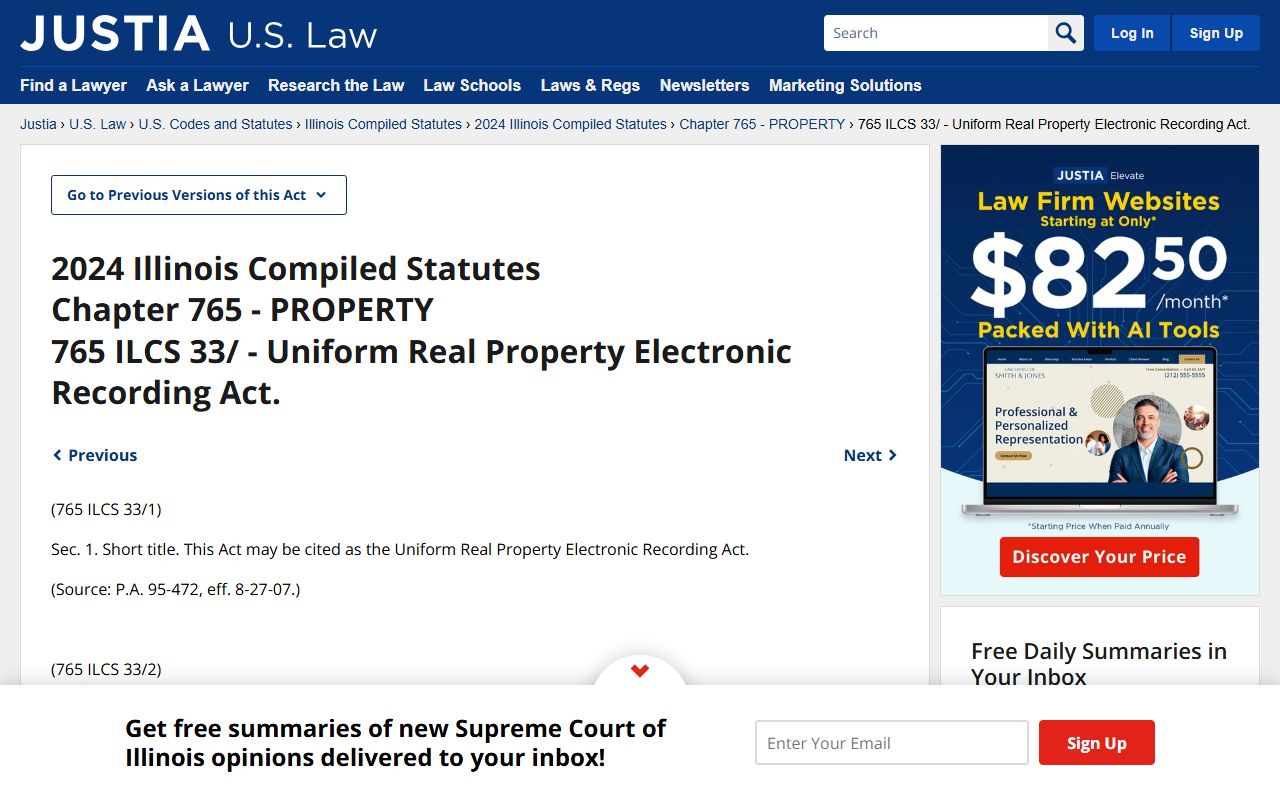
The Illinois Electronic Recording Act at 765 ILCS 33 allows Illinois county recorders to accept documents submitted digitally through approved vendor platforms. When eRecording is active in Hancock County, title companies and lenders can submit deed packages through Simplifile, CSC, EPN, Hopdox, or Indecomm, have the Carthage office process them, and receive stamped copies back electronically without driving to 500 Main St.
Call (217) 357-3911 to ask whether eRecording is currently available at the Hancock County Clerk and Recorder and which vendor platforms the office accepts. Individual sellers and buyers who are not enrolled with an eRecording service bring their signed, notarized deed and MyDec barcode confirmation to the counter at 500 Main St. in person. That is the standard path for any one-time recording in Hancock County and requires no technology setup beyond the MyDec printout.
Types of Instruments Recorded in Hancock County
The Hancock County deed archive at 500 Main St. holds every instrument ever recorded in the county. The collection includes warranty deeds, quitclaim deeds, trustee's deeds, sheriff's deeds from tax and foreclosure sales, land contract memoranda, mortgages, mortgage releases, satisfaction of lien filings, mechanic's liens, judgment liens, easements, right-of-way agreements, subdivision plat maps, survey records, UCC financing statements tied to real property, and DD-214 discharge records for veterans. Each instrument carries a document number and an entry in the grantor-grantee index.
The property tax framework under 35 ILCS 200 is tied to the deed recording process in a direct way. Sale price data from PTAX-203 forms filed with Hancock County deeds goes to the assessor's office, which uses it to calibrate market values for tax assessment. When you look at an older deed in the Carthage archive, the revenue stamps on the document give an indication of what the property sold for at that point in time. That is useful context when tracing ownership history for any parcel in Hancock County.
Nearby Counties
Land near a Hancock County border may have deed records filed with a neighboring county recorder. Each office below maintains its own separate archive for all property instruments recorded within its boundaries.