
Search Bond County Deed Records
Bond County deed records are maintained by the County Clerk in Greenville and document every real property transaction filed in the county, from warranty deeds and quitclaim deeds to mortgages, liens, and easements. This page covers how to search those records, what it costs to record a document, and what requirements apply under Illinois law.
Bond County at a Glance
- County Seat: Greenville
- Population: 16,716
- Office: Bond County Clerk
- Address: 203 W. College Ave., Greenville, IL 62246
- Phone: (618) 664-0449
- Hours: Monday-Friday, 8:00 AM - 4:30 PM
The Bond County Clerk as Recorder
Bond County is one of many Illinois counties where the County Clerk also handles deed recording duties. The office at 203 W. College Ave. in Greenville is where you go to file or search any instrument affecting real property in Bond County. When a deed is recorded, the clerk logs it in the grantor-grantee index, assigns a document number, and notes the exact date and time it was received. That information becomes the permanent public record.
Illinois deed recording law under 765 ILCS 5 requires that deeds be signed and notarized before they can be recorded. The property index number (PIN) from the county assessor must also appear on the document. A 3-inch by 5-inch blank area in the upper right corner of the first page is reserved for the clerk's recording stamp. Documents that arrive without these basics will be returned without being filed.
The PTAX-203 Real Estate Transfer Declaration is required for most property transfers. The Illinois Department of Revenue provides instructions for completing that form correctly.
The PTAX-203 form must accompany most deeds at the time of recording.
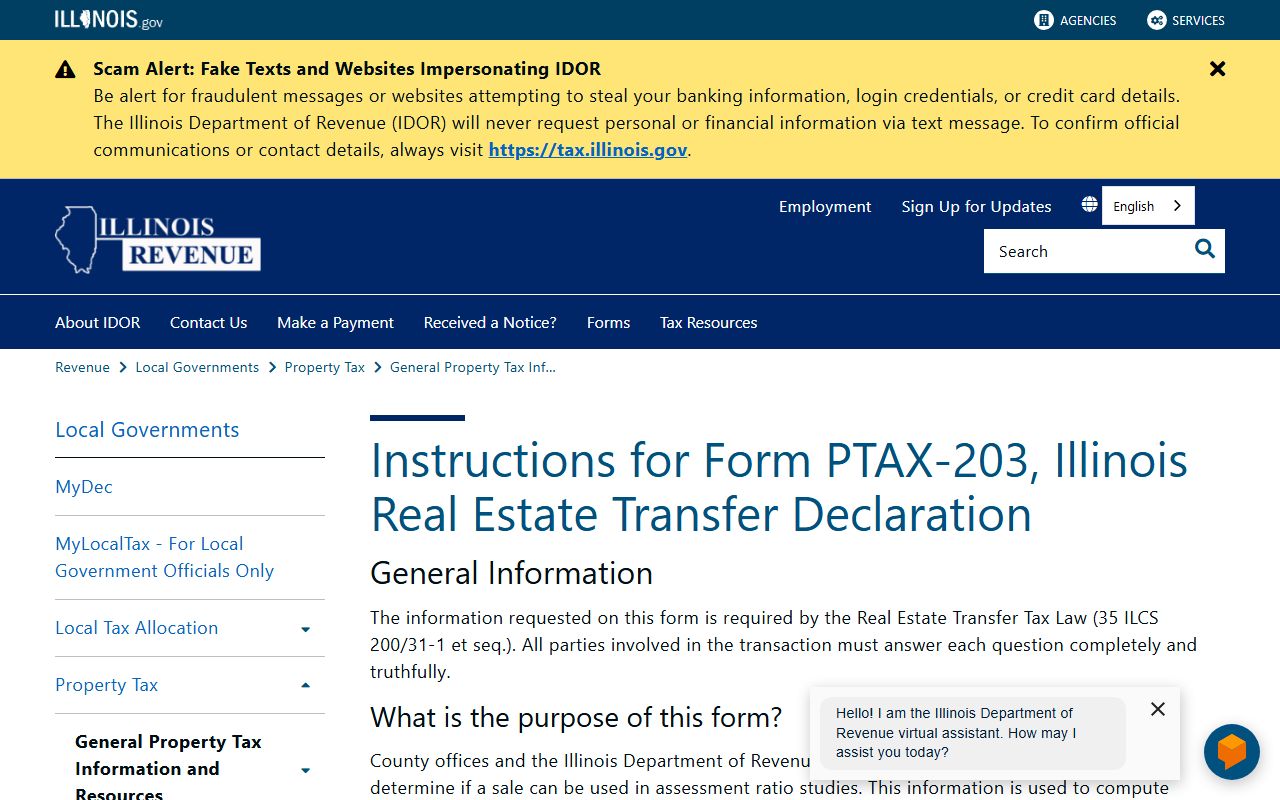
Even transfers that qualify for an exemption from transfer taxes must still file the PTAX-203. The form documents the nature of the transfer and the reason for any exemption claimed. The clerk will not accept a deed without it, with very limited exceptions.
Recording Fees for Bond County
Recording fees in Bond County follow the statewide schedule established under 55 ILCS 5/3-5018. The standard fee is $50 for the first four pages of a document and $1 for each page after that. A Rental Housing Support Program (RHSP) surcharge of $18 per document is added on top. These fees apply to deeds, mortgages, liens, releases, and most other recorded instruments.
Transfer taxes are also collected at recording. The state real estate transfer tax is $0.50 for every $500 of consideration, or fraction thereof. Bond County adds a county transfer tax of $0.25 per $500. On a $150,000 sale, the state tax is $150 and the county portion is $75. These amounts are separate from the recording fee and are paid to the clerk at the same time.
Veterans recording a DD-214 military discharge document pay no recording fee under state law. That exemption is honored at the Bond County Clerk's office just as it is in every other Illinois county.
How to Search Deed Records in Bond County
The most reliable way to search Bond County deed records is to visit the clerk's office in Greenville. Staff can walk you through the index system and help you locate documents by grantor name, grantee name, PIN, or document number. The in-person terminal at the courthouse is the primary public access point for records searches. There is no charge to search; copies cost a per-page fee.
For older records, Bond County's deed books go back to the county's formation in 1817. Some of those early records may be available on microfilm through the Illinois Regional Archives Depository (IRAD) at Southern Illinois University Edwardsville. IRAD provides access to historical government records from counties in southwestern Illinois, including Bond County.
Call (618) 664-0449 before visiting to confirm current hours and ask whether any online search option is available. Small counties sometimes add remote access through a vendor portal, and that can change year to year.
Illinois property transfer tax rules under 35 ILCS 200 govern how taxes are calculated on real estate transfers across the state.
Section 31-10 of 35 ILCS 200 specifically covers the state transfer tax rate and the obligations of the grantor. The county clerk collects the tax and affixes revenue stamps to the deed as evidence of payment. Those stamps are part of the official recorded document.
Document Formatting Requirements
Bond County follows the same document standards as every other Illinois county. Paper must be white and between 8.5 by 11 inches and 8.5 by 14 inches. Font must be at least 10-point and clearly legible. Margins must be at least one-half inch on all sides. The upper right of the first page needs an unprinted 3-by-5-inch block for the recording stamp.
The grantor's signature must be notarized. The grantee's complete mailing address must be in the document. The name and address of the person who prepared the deed must also appear. These requirements come directly from 765 ILCS 5 and cannot be waived. If any piece is missing, the clerk will return the document unfiled.
Electronic Recording in Bond County
Illinois authorized electronic deed recording through 765 ILCS 33, the Uniform Real Property Electronic Recording Act. Under this law, counties may accept documents submitted through approved vendors like Simplifile, CSC, EPN, Hopdox, or Indecomm. Contact the Bond County Clerk at (618) 664-0449 to ask whether eRecording is currently active and which platforms the office accepts.
When eRecording is available, it lets title companies and lenders submit documents, pay fees, and receive stamped copies without going to the courthouse. The documents go through the same review as paper filings, but the turnaround is often same-day. This is especially useful for transactions that close late in the business day.
Requesting Copies
Certified copies of recorded deeds are available from the Bond County Clerk. A certified copy carries the clerk's seal and signature and is accepted as legal proof of the recorded document. The per-page fee and certification charge are set by statute; call the office at (618) 664-0449 for the current rate schedule. Plain copies cost less and are fine for most reference purposes.
Mail requests are accepted. Include the document number if you have it, or give a full property description and the names of the parties. Include a self-addressed stamped envelope and a check or money order for the estimated fee. If the actual cost differs, the office will contact you before returning the documents.
Illinois Legal Aid Online explains the process of filing and copying property documents at county recorder offices, which can be helpful for individuals handling a transaction without an attorney.
Nearby Counties
If a property crosses county lines or you need records from surrounding areas, check these neighboring counties.