
Search Montgomery County Deed Records
Montgomery County deed records are maintained by the Montgomery County Clerk and Recorder in Hillsboro, Illinois. The office serves as the official repository for all deeds, mortgages, liens, easements, and other land instruments recorded in the county. If you are searching deed records in Montgomery County for a title search, a property sale, or a legal matter, the Recorder's Office at 127 N. Main St. in Hillsboro is the correct starting point, and the public index is available for walk-in searches at no charge during regular business hours.
Montgomery County at a Glance
- County Seat: Hillsboro
- Population: 27,942
- Office: Montgomery County Clerk & Recorder
- Address: 127 N. Main St., Hillsboro, IL 62049
- Phone: (217) 532-9530
- Hours: Monday-Friday, 8:00 AM - 4:30 PM
Montgomery County Clerk and Recorder
The Montgomery County Clerk and Recorder office is at 127 N. Main St., Hillsboro, IL 62049, and can be reached at (217) 532-9530. This office is responsible for accepting, stamping, indexing, and permanently archiving all land instruments for Montgomery County. The county seat of Hillsboro is centrally located in south-central Illinois, and the county's land records reflect decades of agricultural, residential, and commercial property transactions across the county's townships.
When a deed is brought to the Hillsboro office, staff check that it satisfies Illinois recording requirements, assign a document number and recording date, and enter both the grantor and grantee names into the index. The document becomes part of the official public archive on the day it is accepted. Anyone may search the index during business hours without charge. The index runs from the county's oldest recorded instruments to the most recent filing, giving researchers a complete picture of land ownership in Montgomery County over time.
Beyond standard deed conveyances, the Montgomery County Recorder's Office in Hillsboro also accepts mortgages and releases, mechanic's liens, judgment liens, easements, plat maps, subdivision plats, UCC filings related to real property, and DD-214 military discharge records for veterans. Each document receives its own unique document number and is indexed under both party names. This indexing system allows any member of the public to search the archive by name to find instruments affecting any parcel in Montgomery County.
Illinois Legal Aid Online, shown below from illinoislegalaid.org, provides a plain-language guide to the county recorder filing process that applies directly to deed recordings at the Hillsboro office.
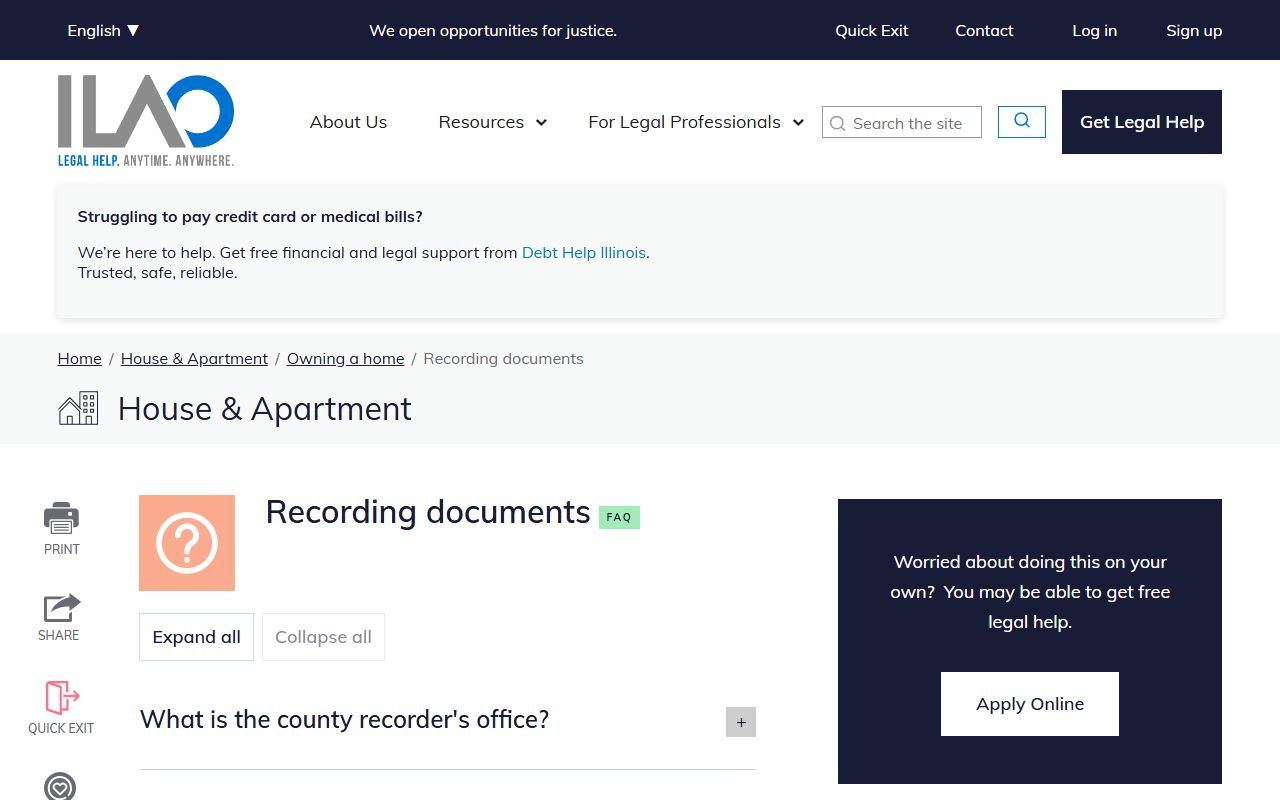
The Legal Aid resource walks through what the Recorder's Office checks when a document arrives, what common errors cause a deed to be rejected in Hillsboro, and how to correct a returned document before resubmitting it.
Recording a Deed in Montgomery County
Every deed recorded in Montgomery County must comply with 765 ILCS 5, the Illinois Conveyances Act. The deed must name the grantor and grantee by full legal name, contain a complete legal description of the property, and carry a notarized acknowledgment of the grantor's signature. The document also needs at least a three-inch by five-inch blank area in the upper right corner of the first page so the Hillsboro office can apply the recording stamp without covering any text.
The parcel identification number must appear on every deed filed at the Montgomery County Recorder's Office. The PIN connects the deed to the county assessor's records and is required under Illinois law before the Recorder can accept the instrument. If you are unsure of the PIN for a Montgomery County parcel, the county assessor's office in Hillsboro can provide it. Having the PIN ready before your visit prevents a delay at the counter.
Most taxable property transfers in Montgomery County must be accompanied by a completed PTAX-203 Real Estate Transfer Declaration. Exempt transfers, such as deeds conveying property between spouses or transfers into a revocable living trust, still require recording at the Hillsboro courthouse; the PTAX-203 for an exempt transfer must include the applicable exemption code. The form can be completed online through the Illinois MyDec system before you arrive in Hillsboro.
Transfer Tax and Recording Fees in Montgomery County
Illinois levies a real estate transfer tax under 35 ILCS 200. The state rate is $0.50 per $500 of consideration. Montgomery County adds $0.25 per $500 on top of the state tax. On a $90,000 farmland sale near Hillsboro, the state tax comes to $90 and the county portion adds $45, for a combined $135. Transfer tax stamps are applied at the Recorder's counter at the time of recording. The seller typically pays this tax, though the purchase contract can assign it to either party.
Recording fees in Montgomery County are governed by 55 ILCS 5/3-5018, the state statute that sets the per-page and per-document rates that county recorders may charge. Call (217) 532-9530 to confirm the current fee schedule at the Hillsboro office before your visit. The fee schedule can change when the Illinois General Assembly amends the statute.
Every document recorded in Illinois carries a mandatory $18 Rental Housing Support Program fee per instrument. This surcharge is collected at the Montgomery County Recorder's Office and is separate from the base per-page recording fee. It applies to deeds, mortgages, liens, and most other land instruments filed in Hillsboro. Plan for this fee in addition to the per-page charge when budgeting for a recording in Montgomery County.
The IDOR PTAX-203 instructions page, shown below from tax.illinois.gov, explains how to calculate the transfer tax and which transfers in Montgomery County are exempt from the state and county tax.
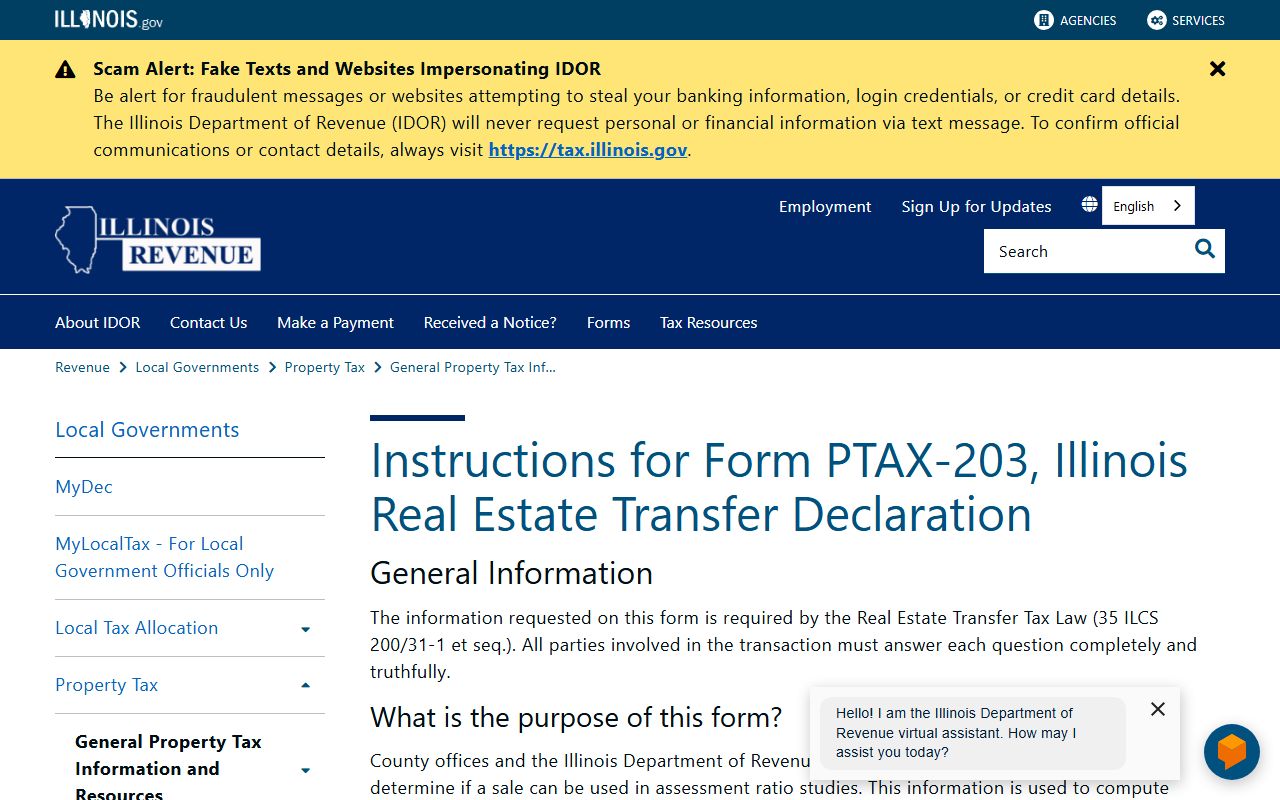
The IDOR instructions walk through the tax computation step by step and list every statutory exemption code that can apply to a Montgomery County deed, including family conveyances, trust transfers, and estate-related deeds.
Searching Montgomery County Deed Records
The public index at the Montgomery County Clerk and Recorder office in Hillsboro is open for walk-in searches during normal business hours. Anyone may search without a fee. The index is organized by grantor and grantee name, so bringing the current owner's name, the property address, or the parcel identification number to the Hillsboro office gives you the best starting point. Staff can direct you to the correct index terminal or book but do not conduct searches on behalf of the public.
A complete title search in Montgomery County involves tracing the grantee index from the current owner back through each prior conveyance. This chain-of-title work often covers many decades of records in the Hillsboro archive. The county's agricultural character means that some parcels have passed through multiple generations of the same family with few recorded transfers, while other parcels have more frequent entries due to estate settlements, refinancings, and sales.
Mail-in record requests are accepted at 127 N. Main St., Hillsboro, IL 62049. Include a written description of the record you need, the party names and approximate recording dates, and a check or money order for the applicable copy fee. The Hillsboro office mails results when the search is done. For most deed record requests in Montgomery County, visiting in person is faster than using the mail.
eRecording in Montgomery County
The Illinois Electronic Recording Act at 765 ILCS 33 authorizes county recorders to accept deed submissions through approved electronic platforms. When eRecording is active, title companies and lenders can submit deeds and other instruments to the Montgomery County Recorder in Hillsboro without sending a physical document to the courthouse. The Recorder processes the file and returns a stamped electronic copy through the same vendor system, typically the same day.
Approved eRecording vendors in Illinois include Simplifile, CSC, EPN, Hopdox, and Indecomm. Contact the Hillsboro office at (217) 532-9530 to find out which vendors the Montgomery County Recorder currently accepts and whether eRecording is active for your document type. Individuals who are not set up with an eRecording account should bring the signed and notarized deed to the Hillsboro courthouse along with the completed MyDec barcode confirmation.
Nearby Counties
Property near a Montgomery County border may have deed records filed in a neighboring county's recorder office. Each keeps an independent land record archive.