
Search Shelby County Deed Records
Shelby County deed records are maintained by the Shelby County Clerk and Recorder in Shelbyville, Illinois. The office files and indexes all recorded property instruments for the county, including deeds, mortgages, liens, and easements. Anyone who needs to search deed records in Shelby County, whether for a title review, a property purchase, or an estate matter, works through the Shelbyville courthouse office.
Shelby County at a Glance
- County Seat: Shelbyville
- Population: 20,720
- Office: Shelby County Clerk & Recorder
- Address: 301 E. Main St., Shelbyville, IL 62565
- Phone: (217) 774-4421
- Hours: Monday-Friday, 8:00 AM - 4:30 PM
Shelby County Clerk and Recorder Office
The Shelby County Clerk and Recorder operates out of 301 E. Main St. in Shelbyville. The office is responsible for recording and indexing all documents that affect real property in Shelby County. Warranty deeds, quitclaim deeds, trustee's deeds, mortgages, mortgage releases, mechanic's liens, easements, survey plats, and other land instruments all go through this office. When a document is accepted, it receives a recording date and document number that identifies it in the county's permanent index.
Shelby County uses a grantor-grantee indexing system. The grantor is the party conveying an interest, the grantee is the party receiving it. Looking up a name in the grantor index shows all documents where that person or entity transferred something; the grantee index shows all documents where they received something. Together, these indexes let title researchers trace the chain of ownership for any parcel in the county. The Shelbyville office maintains both historical and current index records.
Shelby County sits in central Illinois and includes Lake Shelbyville, which has brought a significant volume of recreational and residential property transactions over the decades. Deeds, easements, and access agreements related to lakefront lots and surrounding land appear in the recorder's records alongside standard farmland and residential transactions. If you are researching a property near the lake, be prepared for a potentially more complex title history than a typical town lot.
The Illinois Department of Revenue's PTAX-203 transfer declaration form, shown below from the Illinois Department of Revenue's instructions page, is required for most Shelby County deed filings that involve a sale.
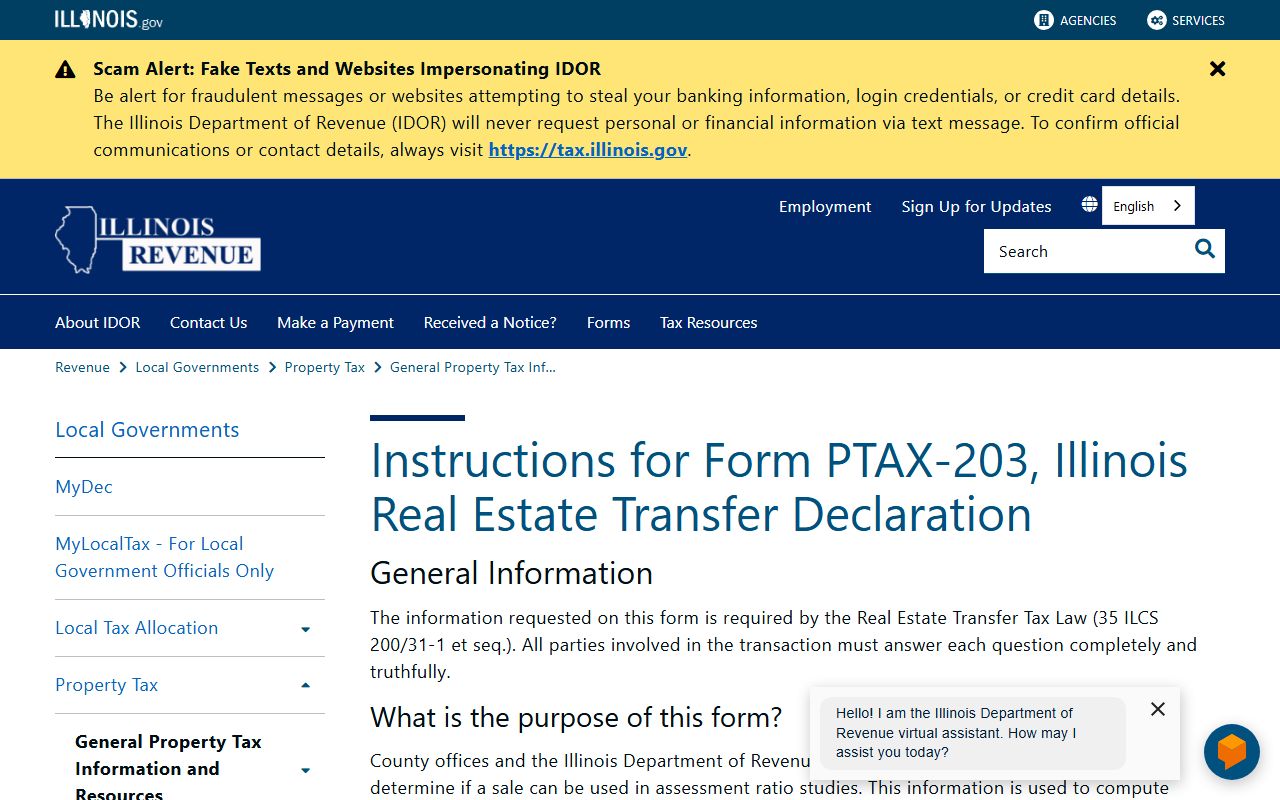
The PTAX-203 instructions detail which transfers are taxable, how to calculate the tax, and which exemptions apply. Completing this form correctly before filing a deed in Shelbyville keeps the transaction moving without counter rejections.
Recording a Deed in Shelby County
Deeds recorded in Shelby County must comply with 765 ILCS 5, Illinois's Conveyances Act. The law sets out core requirements: a named grantor, a named grantee, a valid legal description, and a notarized acknowledgment. The Recorder will reject any deed that does not meet these requirements. Documents are checked at the counter before acceptance, and a rejected deed is handed back rather than recorded in a defective state.
The legal description in a Shelby County deed must match what is on file with the county assessor and on prior recorded instruments. Shelby County uses the Public Land Survey System, so descriptions typically cite a township, range, section, and subdivision of section. For older rural parcels, a metes-and-bounds description may appear. Either way, the description needs to be precise. A deed that describes the wrong acreage or the wrong section will cause title problems that take time and legal work to fix.
Every deed filed in Shelby County must carry the parcel identification number (PIN) on its face. The PIN connects the recorded instrument to the assessor's parcel database. You can find the PIN on a prior deed, on a tax bill, or by calling the Shelby County Assessor. Do not skip the PIN. Without it, the recorder will not accept the document.
Documents must also meet format standards: a 3-inch by 5-inch blank space in the upper right corner of the first page for the recorder's stamp, clear type or legible handwriting, and margins adequate for scanning. Illinois has moved toward uniform document standards statewide, and Shelby County follows those rules.
Transfer Tax and Recording Fees
Illinois imposes a real estate transfer tax under 35 ILCS 200. The state rate is $0.50 per $500 of consideration. Shelby County adds $0.25 per $500. On a $150,000 sale anywhere in Shelby County, the state tax comes to $150 and the county adds $75, for a combined $225. Tax stamps are applied to the deed at the recorder's counter. These are seller-paid taxes in most transactions, though contract terms can shift the obligation.
The Rental Housing Support Program surcharge (RHSP) adds $18 per document recorded. Per-page recording fees apply on top of that. For exact current fee amounts, call (217) 774-4421 before visiting. Fee schedules sometimes change by ordinance and are not always updated promptly online. Knowing the exact amount due means you can bring the right check or cash to the Shelbyville office.
Veterans recording a DD-214 military discharge document in Shelby County generally pay no recording fee. The clerk will confirm eligibility at the counter. This exemption covers the DD-214 itself. Other documents filed by a veteran are subject to standard fees.
If a deed transfer qualifies for an exemption from the PTAX-203 requirement, such as a transfer to a trust or a gift between family members, the exemption code must still be noted on the face of the document or on a cover sheet. Do not simply skip the form and assume the Recorder will sort it out. Document the exemption explicitly.
Searching Shelby County Property Records
The core search tool at the Shelby County Clerk and Recorder is the grantor-grantee name index. You give the office a name, they look it up in the index, and you get a list of documents that name was a party to. From there, you pull the documents to read the actual deed or mortgage language. This process works for current and historical records going back to the county's early period.
Some Shelby County deed records may be available through an online portal. Whether the county has contracted with a third-party vendor for remote access depends on current county decisions. Call the office at (217) 774-4421 or check the county's official site to find out what is accessible online. Third-party data aggregators also carry Shelby County deed data, but they charge fees and may not reflect the most recent filings.
Title companies working in the Shelbyville market search the recorder's index as part of their standard process. A full title search in Shelby County typically covers at minimum the prior 40 years of records, checking for gaps in the chain of title, unreleased mortgages, open liens, and encumbrances that might affect the buyer. If you are buying property in Shelby County, the title commitment from your closing company reflects the results of that search.
For farmland in Shelby County, the search may also turn up drainage district assessments, crop share agreements recorded as covenants, and agricultural easements. These instruments affect land use and value and show up in the recorder's index alongside standard deed instruments.
Electronic Recording Options
Under 765 ILCS 33, Illinois county recorders may accept electronically submitted documents through approved platforms. The main eRecording services active in Illinois are Simplifile, CSC, EPN, Hopdox, and Indecomm. Whether Shelby County currently accepts eRecording through any of these services is best confirmed directly with the office at (217) 774-4421. Title companies and real estate law firms that regularly file in Shelbyville would know the current setup.
When eRecording is available, the workflow is efficient. A title company or attorney uploads the final signed and notarized deed in PDF format. The platform sends it to the Recorder's review queue. If accepted, the Recorder applies recording data and returns the certified document electronically. For high-volume filers, eRecording eliminates courier costs and speeds up the turn time considerably.
For individuals handling a one-time filing, in-person submission at 301 E. Main St. remains straightforward. Mail submission is also generally accepted. Include the correct fees, a prepaid return envelope, and any required accompanying documents like the PTAX-203 form. Call first to confirm the mail process and current fee totals so nothing comes back unprocessed.
Related Property Records in Shelby County
Mortgages recorded in Shelby County are in the same index as deeds. A recorded mortgage creates a lien on the property. When the loan is paid off, the lender records a release. If a mortgage appears in the index without a corresponding release, the lien may still be active. Title researchers check both mortgage instruments and releases to confirm a property is free of encumbrances before a sale closes.
The Shelby County Assessor maintains parcel maps and tax records that connect to the deed records. The assessor's data includes ownership, assessed value, and tax status. If a property has delinquent taxes, that can affect the sale. The county treasurer's office tracks tax payment history. Both the assessor and treasurer work alongside the recorder in the day-to-day property records ecosystem in Shelbyville.
The Shelby County Circuit Court handles foreclosure proceedings. When a lender files to foreclose, the case is in circuit court, and any resulting judgment or sheriff's deed is recorded with the Clerk and Recorder. A full title search in Shelby County checks both the recorder's index and circuit court records to make sure no active foreclosure affects the property being sold.
Nearby Counties
Shelby County is in central Illinois, bordered by several counties with their own deed record offices.