
Christian County Deed Records Search
Christian County deed records are filed with the Christian County Clerk & Recorder in Taylorville, Illinois, and document every conveyance, mortgage, lien, and easement affecting land in the county. Searching Christian County deed records is how buyers, sellers, lenders, attorneys, and genealogical researchers confirm current ownership, trace past ownership changes, and identify any encumbrances on a parcel before a transaction closes. The public grantor-grantee index goes back to the county's founding, and the office in Taylorville maintains access to instruments spanning warranty deeds, quitclaim deeds, trustee deeds, and a wide range of other real estate documents filed over the county's history.
Christian County at a Glance
- County Seat: Taylorville
- Population: 33,538
- Office: Christian County Clerk & Recorder
- Address: 101 S. Main St., Taylorville, IL 62568
- Phone: (217) 824-4969
- Hours: Monday-Friday, 8:00 AM - 4:30 PM
The Christian County Clerk & Recorder Office
The Clerk & Recorder office in Taylorville manages both election records and real estate instruments for Christian County under one administration. The recording division indexes all documents affecting real property in the county, accepts new instruments for recording, issues certified copies, and provides public access to the index during regular business hours. For a straight deed search or a full chain-of-title review, the office at 101 S. Main St. is the place to start.
Christian County sits in central Illinois, bounded by Sangamon, Macon, Shelby, Montgomery, Macoupin, and Morgan counties. Agricultural land is a major part of the county's makeup, and farm transactions in this region often involve large acreages with detailed legal descriptions, drainage easements, and access roads. These instruments all get recorded with the Clerk/Recorder and become part of the public record.
Taylorville is roughly 25 miles southeast of Springfield. Researchers who need records from both Christian County and neighboring Sangamon County (which includes Springfield) should plan visits to both offices, since a county-line parcel may have relevant documents in each recorder's index.
The image below shows the Illinois Legal Aid recording guide, a plain-language resource explaining how to file documents at county recorder offices in Illinois, including what the public can access and how to get certified copies of deed records.
Source: Illinois Legal Aid Recording Guide
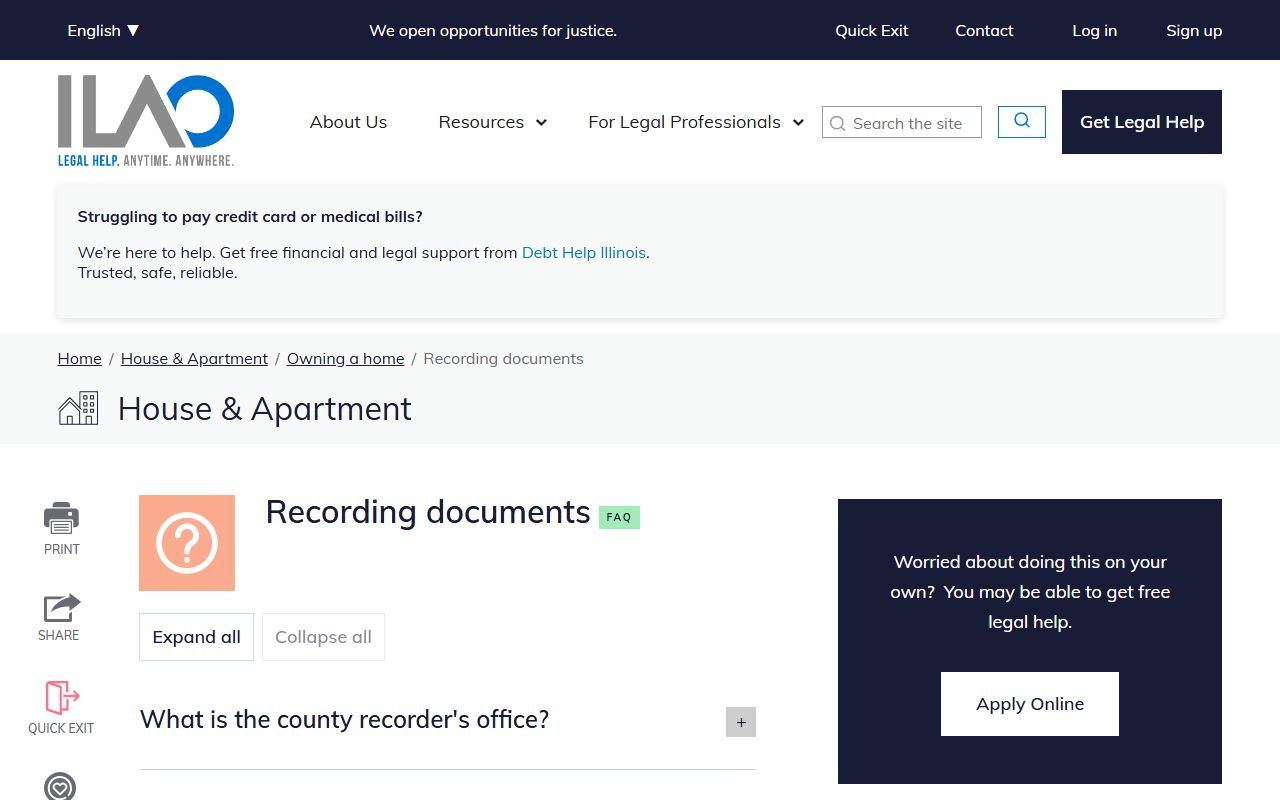
The Illinois Legal Aid guide is a good starting point if you're new to searching deed records at a county recorder's office. It explains the difference between certified and uncertified copies, who can access the index, and what types of documents typically appear in the record.
How to Search Deed Records in Christian County
Walk-in access to the grantor-grantee index at the Taylorville courthouse is free and open to the public. You can search by party name (grantor or grantee) or by property index number (PIN). Terminals are usually available at the counter for digital records. Older instruments may be in bound volumes or on microfilm depending on the year they were recorded.
When you locate a document, you can order a copy at the counter. Certified copies carry the recorder's official seal and are needed for legal filings, title insurance, and real estate closings. Uncertified copies are cheaper and work fine for personal reference or research. Fees for copies are set by state statute.
If you cannot visit in person, call (217) 824-4969 to ask about online search options or the mail request process. Some Illinois counties have expanded digital access in recent years, and Christian County may have options available that aren't widely advertised online.
Recording Requirements
Illinois deed recording requirements come from 765 ILCS 5, the Conveyances Act. Every deed submitted to the Christian County Clerk/Recorder must meet these standards. Documents that don't comply will be returned unrecorded.
Required for every deed:
- Notarized grantor signature with notary's printed name and commission expiration date
- Property Index Number (PIN) printed on the face of the document
- Complete legal description of the property
- Grantee's full name and mailing address
- Preparer's name and address
- A blank 3-inch by 5-inch area in the upper right corner of the first page for the recorder's recording stamp
The Clerk/Recorder does not correct deficient documents or give legal advice about deed content. An attorney or title company should review the document before submission if there is any question about whether it meets all requirements.
Fees and Transfer Taxes
Recording fees in Christian County are governed by 55 ILCS 5/3-5018. The base fee covers the first page; additional pages carry a lower per-page rate. Contact the office at (217) 824-4969 for the current schedule, as rates are subject to change when the legislature updates the statute.
Transfer taxes apply to most deed conveyances under 35 ILCS 200. The state collects $0.50 per $500 of consideration. Christian County collects an additional $0.25 per $500. Both are paid at the time of recording. Certain transfers are exempt by statute, but even exempt transactions need a transfer declaration filed at recording.
An $18 Rental Housing Support Program (RHSP) surcharge applies to most recorded documents. This is a flat per-document fee that goes to a statewide affordable housing fund. It does not vary with page count or consideration amount.
Transfer Declarations: MyDec and PTAX-203
Every deed transfer in Illinois requires a Real Estate Transfer Declaration. You can complete it online through the MyDec portal on the Illinois Department of Revenue's website. Many counties now require MyDec instead of the paper PTAX-203 form. Christian County may follow this requirement, so confirm with the office before you arrive with a paper form.
The declaration captures the consideration amount, property details, buyer and seller information, and transfer type. Even exempt transactions need the form filed with the exemption code noted. The PTAX-203 instructions explain how to complete each section and which supplemental schedules may apply for specific transaction types like estate deeds or transfers into trust.
Filing an incomplete declaration or one with incorrect information can slow the recording and may result in a follow-up inquiry from the Illinois Department of Revenue. Take the time to get it right before you go to the counter.
eRecording in Christian County
Illinois permits counties to accept electronically submitted documents under 765 ILCS 33. The approved eRecording vendors for Illinois are Simplifile, CSC, EPN, Hopdox, and Indecomm. Call the Christian County Clerk/Recorder at (217) 824-4969 to confirm which vendors have active connections to the county and how to enroll.
eRecording is especially useful for title companies and law firms that record regularly in multiple counties. Documents are submitted digitally, reviewed by recorder staff, stamped with the recording information, and returned electronically. Turnaround is often the same day or next business day, which is faster than mail or courier.
The image below shows the 35 ILCS 200 real estate transfer tax statute, which governs the state and county transfer taxes that apply when deed records are recorded in Christian County and throughout Illinois.
Source: 35 ILCS 200 Real Estate Transfer Tax
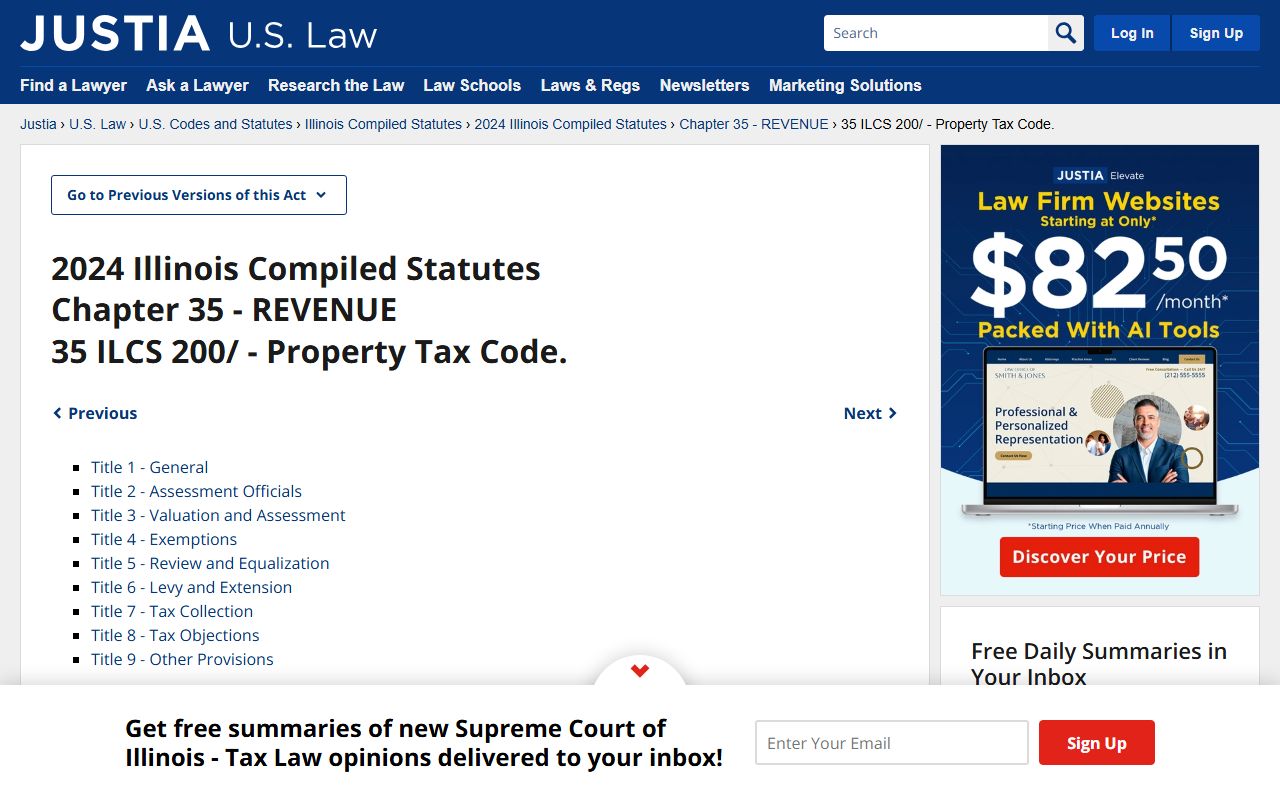
The 35 ILCS 200 statute page sets out the transfer tax rates, exemptions, and declaration requirements that apply to deed recordings in Christian County. Reviewing it before your transaction helps you calculate costs and identify whether any exemption applies to your transfer.
What Gets Recorded in Christian County
The Clerk/Recorder's index includes far more than just basic deeds. A thorough title search needs to account for all instrument types that can create or affect interests in land.
- Warranty deeds and quitclaim deeds
- Trustee deeds and Illinois land trust documents
- Mortgages, deeds of trust, and home equity line documents
- Mortgage releases and satisfactions
- Easements and right-of-way instruments
- Plats of subdivision
- Mechanics liens
- Lis pendens notices
- Foreclosure-related documents
- Installment sale contracts
- Memoranda of lease
- Agricultural easements and conservation instruments
- DD-214 military discharge records
Agricultural easements and drainage-related documents appear often in Christian County given the predominance of farm ground. Drainage tile easements and access road grants are common in the index and can affect how a parcel can be used or developed.
Veterans and Free DD-214 Recording
Like most Illinois counties, Christian County records DD-214 military discharge documents for veterans at no cost. Having a DD-214 on file with the Recorder gives veterans a permanent, official backup that can support property tax exemption applications, benefit claims, or the replacement of a lost original. The indexed document is protected from general public copying to keep the veteran's personal information secure while still being accessible to the veteran.
Nearby Counties
Parcels near Christian County's borders may have deed instruments recorded in a neighboring county's recorder office, so check those offices when a legal description runs close to a county line.