
Douglas County Deed Records Search
Douglas County deed records are on file with the Douglas County Clerk and Recorder in Tuscola, Illinois. The office records and indexes all property instruments for Douglas County, including deeds, mortgages, easements, and liens. If you need to search deed records for a parcel in Douglas County, whether to verify ownership, trace a title chain, or look up a past transaction, the Tuscola office is the official source for that information.
Douglas County at a Glance
- County Seat: Tuscola
- Population: 19,751
- Office: Douglas County Clerk & Recorder
- Address: 401 S. Center St., Tuscola, IL 61953
- Phone: (217) 253-2411
- Hours: Monday-Friday, 8:00 AM - 4:30 PM
Douglas County Clerk and Recorder
The Douglas County Clerk and Recorder is at 401 S. Center St. in Tuscola. This office is the legal custodian of all recorded property instruments in Douglas County. Warranty deeds, quitclaim deeds, trustee's deeds, special warranty deeds, executor's deeds, mortgages, releases, mechanic's liens, lis pendens filings, easements, survey plats, and other land instruments all go through the Tuscola office. Each document accepted for recording gets a date, time, and unique document number assigned at the counter.
Douglas County uses the standard Illinois grantor-grantee index system. When you need to search deed records, you look up names in the grantor or grantee index to find what instruments a person or entity has been party to. A grantor search shows documents where that party sold or transferred a property interest. A grantee search shows documents where they received an interest. Linking grantor entries to grantee entries across time lets researchers build out the full chain of title for any Douglas County parcel.
Douglas County is primarily agricultural land in east-central Illinois, with Tuscola as the county seat and Arcola and Arthur as other notable communities. The area's farmland generates a steady volume of deed activity, including transfers between family members, sales to land trusts, and transactions involving drainage district assessments. All of those instruments flow through the Tuscola recorder's office and appear in the county's permanent index.
The Illinois Legal Aid guide to filing at county recorder offices, shown below, gives a plain-language explanation of how the recording process works in Illinois counties like Douglas.
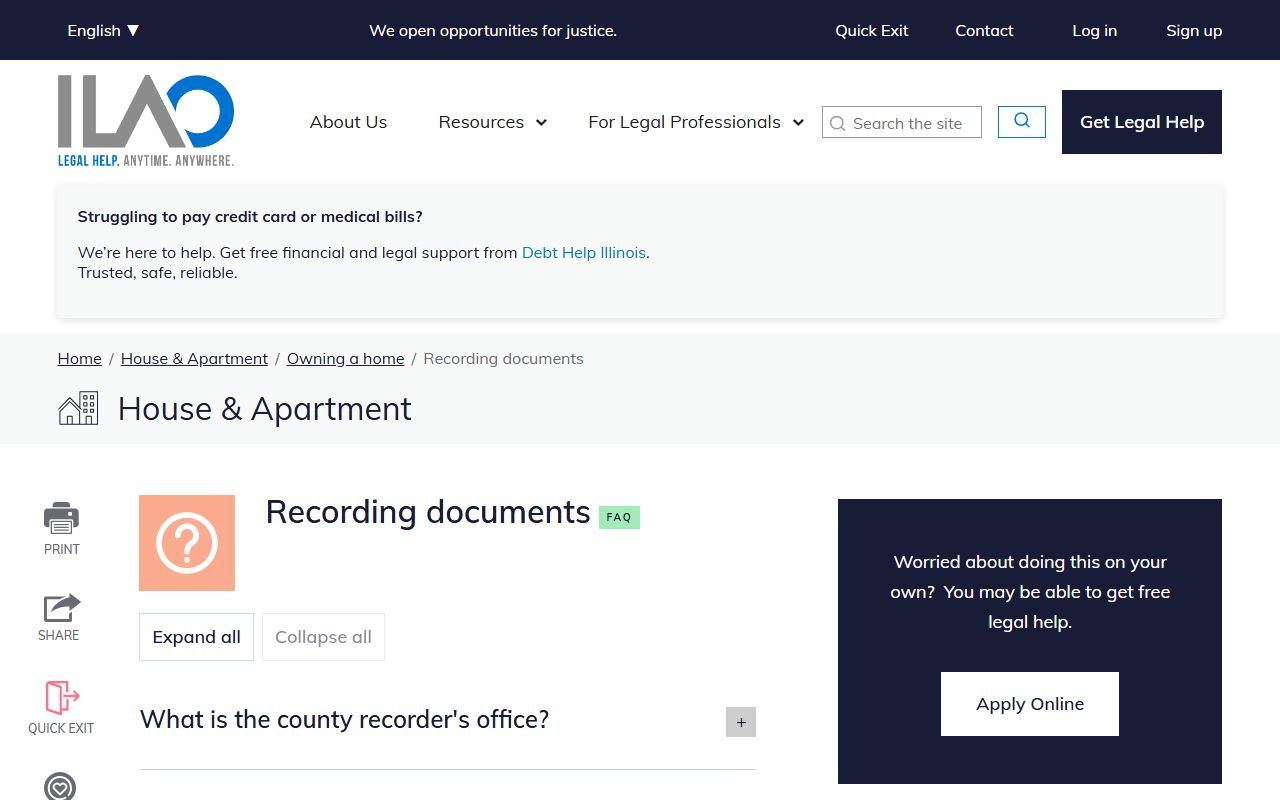
The guide is a useful pre-visit resource. It covers what documents need to include, why filings get rejected, and what to expect at the counter. Worth reading before your first trip to the Tuscola office if you are not familiar with the process.
Recording a Deed in Douglas County
Illinois law at 765 ILCS 5 sets the requirements for valid deeds in the state. A deed submitted in Tuscola must name the grantor and grantee, include a legal description of the property, and carry a notarized acknowledgment. Missing any of these elements means the Recorder rejects the document. Documents do not get provisionally accepted and fixed later. They come back as-is.
Legal descriptions for Douglas County property use the Public Land Survey System. The county lies in a grid of townships and ranges laid out in the original government survey. Proper descriptions cite the section number, township, range, and any subdivision of section that applies. For recorded plat subdivisions around Tuscola or Arcola, descriptions reference the plat book, page, and lot number. Confirming the description matches the county assessor's records before submitting avoids costly corrections after recording.
The parcel identification number (PIN) is required on every deed submitted in Douglas County. The PIN links the recorded instrument to the assessor's parcel database. You can get the PIN from the county assessor, from a prior deed, or from a property tax bill. Do not show up at the Tuscola office without it. Without the PIN, the Recorder will send the document back unrecorded.
Formatting rules also matter. Illinois document standards require a clear 3-inch by 5-inch space in the upper right corner of the first page for the recording stamp. Text must be legible for scanning. Margins need to be adequate. These requirements apply in Douglas County as in every other Illinois county.
For most sale transactions, the PTAX-203 Real Estate Transfer Declaration is required and must accompany the deed. Instructions are at the Illinois Department of Revenue's PTAX-203 instructions page. Complete the form through the MyDec online portal before arriving in Tuscola so the barcode is ready at the counter.
Transfer Tax and Fees
Illinois imposes a real estate transfer tax under 35 ILCS 200. The state rate is $0.50 per $500 of consideration. Douglas County adds $0.25 per $500. On a $200,000 farmland sale in Douglas County, the state takes $200 and the county adds $100, for a total of $300 in transfer taxes. Stamps are applied to the deed at the recording window. In most sales, the seller pays transfer taxes, but contract terms can shift that obligation.
The Rental Housing Support Program surcharge is $18 per document. Per-page recording fees are set by county ordinance. For the current fee schedule, call (217) 253-2411 before visiting. Fees are not always updated promptly on county websites, and bringing the wrong amount means a trip back or a mail follow-up. Cash, check, or money order are the standard payment methods in smaller county offices; credit card acceptance varies.
Veterans recording DD-214 military discharge documents in Douglas County generally pay no recording fee for that specific document. Confirm eligibility with the clerk at the counter. The waiver applies to the DD-214 form; other documents submitted at the same visit are charged at standard rates.
Electronic Recording in Douglas County
Illinois authorizes county recorders to accept electronically submitted documents under 765 ILCS 33. The approved platforms in Illinois include Simplifile, CSC, EPN, Hopdox, and Indecomm. Whether Douglas County currently accepts eRecording through one of these platforms is best confirmed by calling (217) 253-2411 directly. Title companies and attorneys who file regularly in Tuscola will know the current setup.
If eRecording is active in Douglas County, the workflow is efficient for title companies and law firms that file frequently. The preparer uploads the signed and notarized deed in PDF format through the eRecording platform. The platform routes it to the Douglas County Recorder's queue. The Recorder reviews, accepts, and returns the certified document electronically. No in-person visit is required, and same-day processing is possible for documents submitted early enough.
Individual property owners or one-time filers are best served by in-person submission at 401 S. Center St. in Tuscola. Mail submission is also an option. Include the deed, PTAX-203, correct fees, and a prepaid return envelope. Call the office first to confirm the mailing process and current fee totals so nothing comes back unprocessed.
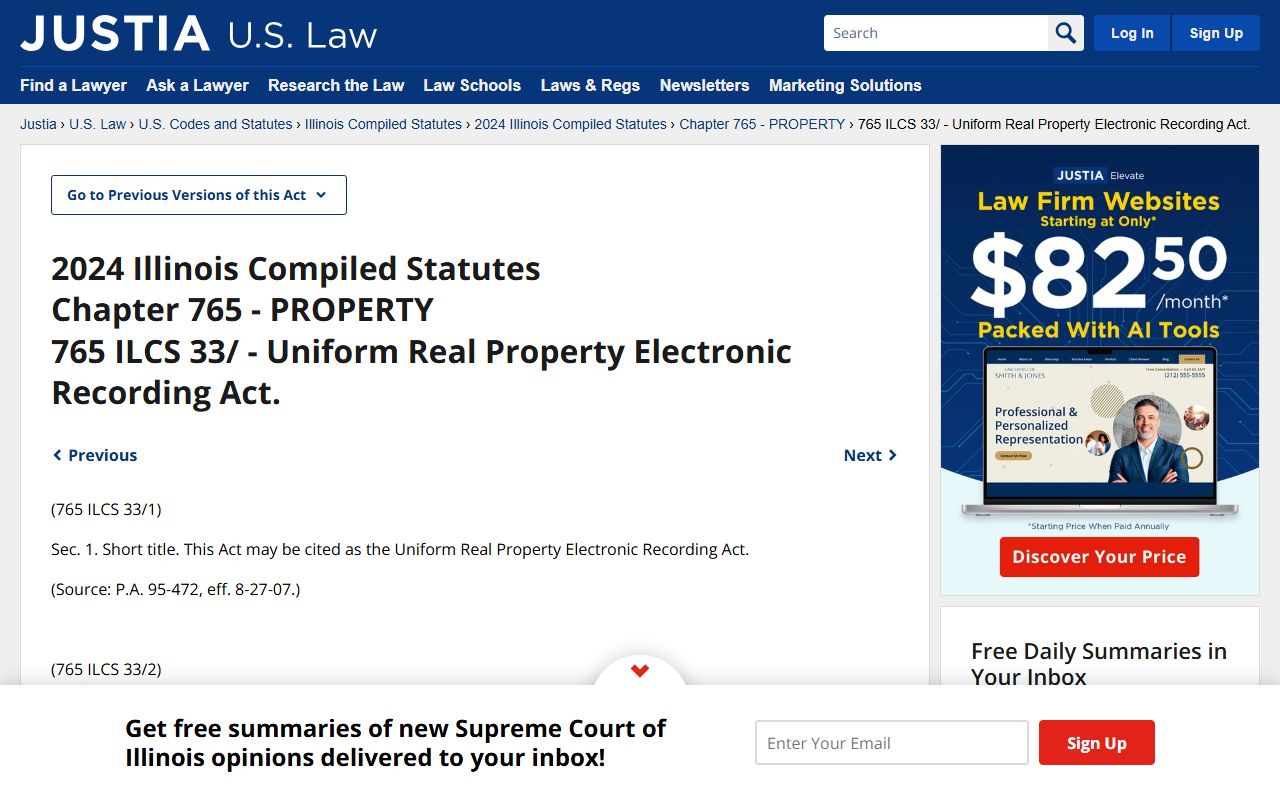
The electronic recording statute shown above is the legal basis for counties like Douglas to accept digital document submissions. Check with the office whether this option is live for Douglas County before planning an eRecording submission.
Searching Douglas County Deed History
Searching the grantor-grantee index at the Tuscola office is the primary method for researching Douglas County deed history. You provide a name, get a list of matching instruments, and pull the documents to read the deed language. Title examiners typically run a 40-year chain at minimum, checking each link from current owner back to prior owner, and confirming that each grantor in a deed received title as a grantee in an earlier one.
Douglas County farmland title searches sometimes turn up drainage district instruments. Drainage districts in east-central Illinois have the authority to assess land and record instruments that affect property. These assessments and agreements appear in the recorder's index alongside standard deeds and mortgages. A full title search for agricultural land in Douglas County checks for open drainage liens in addition to the standard deed chain.
Probate-related deed instruments, such as executor's deeds and administrator's deeds, are recorded with the Clerk and Recorder when an estate conveys property. The related probate case is in the Douglas County Circuit Court. To understand why a particular executor's deed was recorded, you need the circuit court file. The recorder's office holds only the instrument itself.
For recent filings, an online search portal may be available through the county or through a third-party vendor the county has contracted with. Call (217) 253-2411 to find out what remote access is currently available for Douglas County deed records. Third-party property data sites carry aggregated public record data but charge fees and may not reflect the most current filings.
Related Records and Offices
Mortgages and mortgage releases in Douglas County are recorded in the same office as deeds. A title search for any Douglas County property should check for open mortgages with no corresponding release. If a mortgage appears without a release, investigate before closing. The lender may need to provide a payoff confirmation and a release document if one was never recorded after the loan was satisfied.
Mechanic's liens are another category of instruments that appear in the recorder's index. A contractor or supplier who was not paid for work on a Douglas County property can file a lien against that property. Open mechanic's liens must be resolved or bonded off before a clean title can pass. Your title company searches for these as part of a standard commitment.
The Douglas County Assessor's office maintains parcel data and ownership records that are updated when new deeds are recorded. The assessor is a good resource for PIN lookups, parcel maps, and tax status information. The assessor's data tracks the recorder's filings but may lag slightly. For legal ownership confirmation, the recorder's index is the authoritative source.
Nearby Counties
Douglas County is in east-central Illinois, surrounded by counties each with their own deed record offices.