
Champaign County Deed Records
Champaign County deed records are kept by the Champaign County Clerk and Recorder in Urbana, which maintains all land documents filed within the county. To search deed records, you can use the county's online portal, visit the office in person, or submit a written request by mail for copies of specific instruments.
Champaign County at a Glance
- County Seat: Urbana
- Population: 208,741
- Office: Champaign County Clerk & Recorder
- Address: 1776 E. Washington St., Urbana, IL 61802
- Phone: (217) 384-3720
- Hours: Monday-Friday, 8:00 AM - 4:30 PM (2nd Wednesday opens at 9:00 AM)
- Website: champaigncountyclerk.com/recorder-deeds
The Champaign County Clerk and Recorder Office
The Champaign County Clerk and Recorder is the official keeper of all deed records in the county. The office sits at 1776 E. Washington St. in Urbana. It handles recording, indexing, and retrieval of land documents for properties throughout Champaign County. Call (217) 384-3720 during regular business hours if you have questions about a specific document or need help with a search request.
Office hours are Monday through Friday, 8:00 AM to 4:30 PM. On the second Wednesday of each month, the office opens at 9:00 AM rather than 8:00 AM. Plan around this if you intend to come in on that day. The office does not take walk-in appointments; you can arrive anytime during open hours to search records or drop off documents for recording.
The county combines Clerk and Recorder functions under one roof. That means land records, vital records, and election services are handled by the same office. For deed records specifically, the Recorder division is your point of contact. The office website at champaigncountyclerk.com/recorder-deeds has the current fee schedule, recording requirements, and a link to the online search tool.
The screenshot below shows the Champaign County Clerk Recorder homepage, which is where you start for all deed record services in the county.
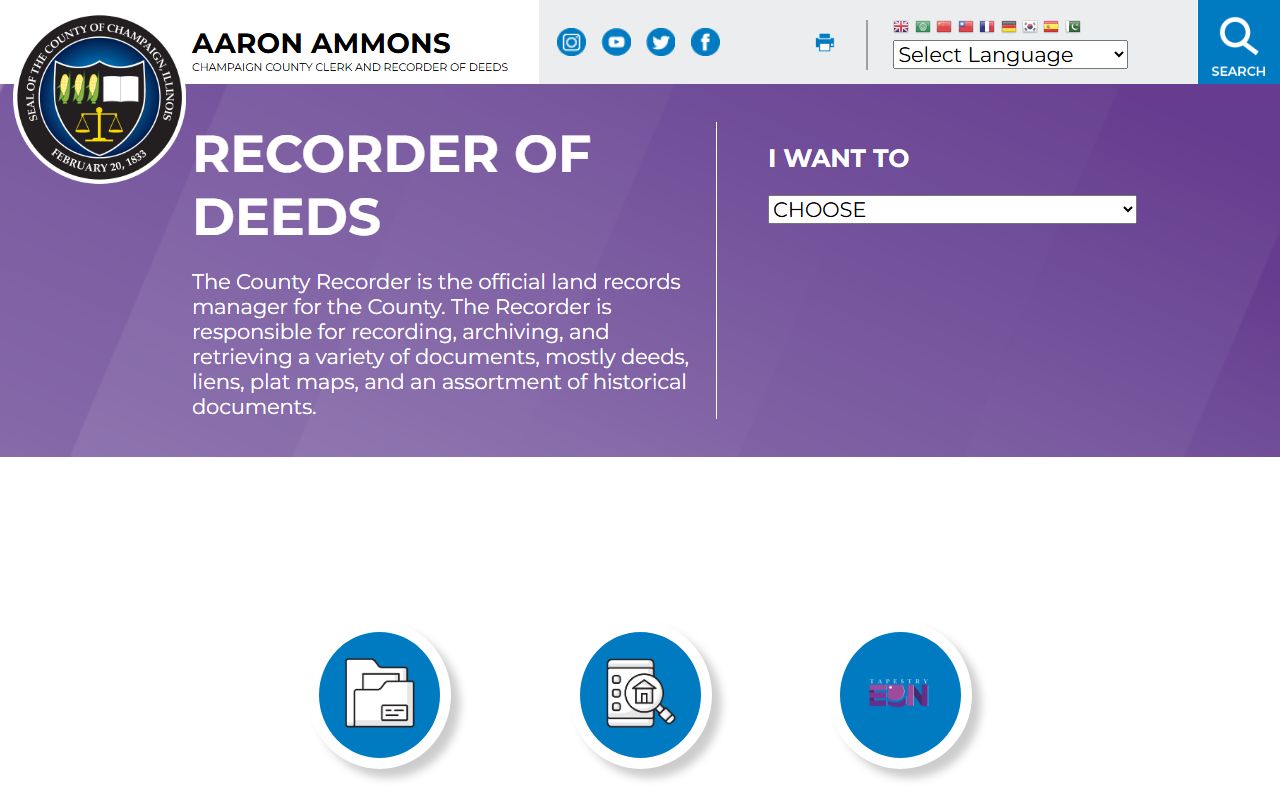
This page links directly to the online records search, recording instructions, current fees, and contact details for the Champaign County Recorder office.
Search Deed Records Online
Champaign County offers public online access to its deed records. You can search by grantor name, grantee name, document type, or recording date range. Most people searching for a property transfer start with a name or a date. The portal covers instruments recorded over many years and is free to use during regular hours.
The Illinois Conveyances Act, 765 ILCS 5, is the state law that governs how deeds must be prepared and recorded in every Illinois county. Under this statute, a deed must be signed, notarized, and include the grantee's name and address. It must also carry the property's Permanent Identification Number (PIN). Documents that fall short of these standards will be returned unfiled.
Not all older records are digitized. Documents recorded before the county's system went live may only be on microfilm or in paper form at the office. In those cases, visiting the Recorder's office in Urbana is the most reliable way to get what you need. Staff can pull microfilm records and make copies for a fee.
If you run into trouble using the online search or need help understanding a document, Illinois Legal Aid has a free guide at illinoislegalaid.org. It covers how recorder offices in Illinois work and what to do if you have questions about a filing. For more complex legal issues involving title or ownership, consult a licensed attorney.
Recording a Deed in Champaign County
To record a deed in Champaign County, your document must meet state standards under 765 ILCS 5. That includes a notarized signature, a full legal description of the property, and the PIN for the parcel. Leave a 3-inch by 5-inch blank space in the upper right corner of the first page. That space is reserved for the recorder's stamp and recording data.
Most deeds tied to a sale also need a completed Real Estate Transfer Declaration. Illinois uses the PTAX-203 form for this. You can fill it out online through the MyDec system at mytax.illinois.gov/MyDec. MyDec gives you a confirmation number to attach to your deed before you submit it. The Illinois Department of Revenue posts full PTAX-203 instructions at tax.illinois.gov.
Gift transfers and certain family conveyances may qualify for a transfer tax exemption. The PTAX-203 includes a section for exemption claims. The MyDec portal walks you through a short set of questions to help determine if an exemption applies. It's worth checking this before you head to the office, since it can save you money and speed up the recording process.
Champaign County accepts eRecording under 765 ILCS 33, the Uniform Real Property Electronic Recording Act. Approved vendors include Simplifile, CSC, EPN, Hopdox, and Indecomm. Electronic submission is especially useful for title companies and law firms that record documents regularly and prefer faster turnaround over in-person filing.
Fees for Deed Recording
Recording fees in Champaign County are governed by 55 ILCS 5/3-5018, which sets the statewide fee framework for recorder offices in Illinois. Standard fees cover the first page and then add a per-page charge for additional pages. Always confirm the current amounts with the Champaign County office before you submit any document, since fees can change.
Illinois also collects a Real Estate Transfer Tax on deed recordings that involve a sale. The state rate under 35 ILCS 200 is $0.50 per $500 of value. The county adds $0.25 per $500. Both taxes are collected at the time of recording. The recorder's office handles collection on the state's behalf and does not separately bill you later.
A Rental Housing Support Program (RHSP) surcharge of $18 applies to most recorded instruments. This is a statewide charge, not specific to Champaign County. It funds housing assistance programs across Illinois. Veterans recording a DD-214 military discharge document pay no fee at all. That waiver applies at recorder offices throughout the state.
Copies of recorded documents have their own fee structure. Non-certified copies are less expensive than certified ones. If you need a copy for your own reference, a plain print is fine. If you need it for a legal proceeding, a loan application, or an estate matter, you likely need a certified copy. Ask the office which type you need before you pay.
What Deed Records Include
A recorded deed in Champaign County identifies the grantor (the person conveying the property) and the grantee (the person receiving it). It includes the legal description of the parcel, the date of transfer, and the recording date assigned by the office. Many deeds also state the consideration paid, though some transfers list only a nominal dollar amount when full disclosure is not required by law.
Beyond deeds, the Recorder's office holds mortgages, releases, liens, easements, plats, and covenants. All of these form part of the Champaign County land records system. When you research a property's history, you may need to look at several document types to build a complete picture of ownership, encumbrances, and releases over time.
Chain of title is the sequence of recorded ownership, connecting one grantor to the next from the earliest record forward. Title companies and attorneys examine the chain before a sale closes. Gaps or errors can delay or block a transaction. Recording your deed promptly after closing protects your ownership and keeps the chain intact.
Some counties in Illinois offer a Property Fraud Alert service. This program notifies property owners when a document is recorded against their parcel. Contact the Champaign County Clerk and Recorder to find out if this service is currently available for your property. It's a free safeguard worth checking on.
Getting Copies of Deed Records
You can get copies of Champaign County deed records through the online portal, in person at the office, or by mail. Online, you can view and print many documents directly from the search results. In person, bring the document number or enough identifying details so staff can locate the record. By mail, send a written request with enough detail to identify the document plus payment for copy fees.
Certified copies are available for an additional charge. A certified copy carries the recorder's seal and signature and is accepted for legal, financial, and court purposes. A plain copy is fine for personal reference. If you plan to use a copy in a title dispute, estate proceeding, or mortgage transaction, confirm in advance whether a certified version is required.
In-person requests for documents in the digital system are usually filled the same day. Older records on microfilm may take longer. Mail requests can take a week or more depending on current office volume. Call (217) 384-3720 for an estimate before sending anything in.
Other Property Records in Champaign County
The Champaign County Assessor keeps property tax and assessment records separate from deed records. If you want to check a parcel's assessed value or look up ownership for tax purposes, the Assessor's database complements what you find in the Recorder's deed index. The two offices cover the same parcels but maintain different systems.
Champaign County GIS maps let you locate parcels visually and match them to PIN numbers. Having the correct PIN before you search deed records saves time and reduces the risk of pulling documents for the wrong property. Search "Champaign County GIS" online to find the current mapping tool for the county.
For legal help with deed problems, quiet title actions, or disputed ownership in Champaign County, Prairie State Legal Services offers free civil legal aid to qualifying residents. They handle matters that go beyond what the recorder's office staff can advise on. Contact them if you need representation or legal advice about a property issue in Champaign County.
The MyDec portal at mytax.illinois.gov/MyDec also stores previously filed transfer declarations. If you need to confirm details of a past sale recorded in Champaign County, the corresponding PTAX-203 may be accessible through MyDec. That can be a useful secondary source when the deed itself does not spell out the full transaction terms.
Cities in Champaign County
The following city in Champaign County has its own deed records page.
Nearby Counties
These counties border Champaign County and maintain their own deed records offices.