
Fulton County Deed Records
Fulton County deed records are maintained by the Fulton County Clerk and Recorder in Lewistown, Illinois, and cover all real property transfers, mortgages, liens, and related instruments recorded within the county. To search deed records, you can visit the recorder's office in person, submit a written request by mail, or use any online access the county makes available through its official portal. The recorder indexes documents by grantor and grantee name and by parcel identification number, so having at least one of these on hand will speed up your search considerably.
Fulton County at a Glance
- County Seat: Lewistown
- Population: 33,020
- Office: Fulton County Clerk & Recorder
- Address: 100 N. Main St., Lewistown, IL 61542
- Phone: (309) 547-3041
- Hours: Monday-Friday, 8:00 AM - 4:30 PM
How to Find Deed Records in Fulton County
The Fulton County Clerk and Recorder is the official custodian of all land records in the county. This includes warranty deeds, quitclaim deeds, deeds in trust, mortgages, releases, plats, and easements. Every document submitted for recording gets a unique document number and is indexed by the names of the parties involved as well as the legal description of the property. The office's records go back to the county's early history, and many older instruments have been microfilmed or scanned to preserve them.
To look up a deed, you need at least one of the following: the grantor or grantee name, the parcel identification number (PIN), or the legal description. If you only know the street address, ask the recorder's staff to help you locate the PIN first, which will then let you find all associated instruments. Staff can help you navigate the index, but they cannot provide legal advice.
Walk-in searches are welcome during regular office hours. Bring a photo ID if you plan to order certified copies. Plain copies are available for a per-page fee, while certified copies carry an additional certification charge. Call ahead to confirm current copy fees before you visit.
Recording Documents in Fulton County
Illinois law sets baseline requirements that every instrument must meet before it can be recorded. Under 765 ILCS 5, all deeds must be signed by the grantor, acknowledged before a notary public, and include the legal description of the property. The recorder cannot accept a document that is missing required elements, so double-check your instrument before submitting it.
A few practical requirements apply to every document submitted in Illinois. The parcel identification number must appear on the deed. There must be a blank space of at least three inches by five inches in the upper right corner of the first page. This space is reserved for the recorder's stamp; do not write or print anything in that area. Pages must be on white paper, standard letter size, with black ink and legible text.
The Real Estate Transfer Declaration form, known as PTAX-203, is required for most conveyances. The Illinois Department of Revenue provides detailed instructions on its website at tax.illinois.gov. This form captures information about the sale price, type of deed, and parties involved, and the data feeds the state's real estate transfer tax calculation. Exemptions apply in certain situations, such as transfers between spouses or gifts, but those must still be documented on the form with the appropriate exemption code.
Transfer taxes in Illinois are split between the state and the county. The state imposes a tax of $0.50 for every $500 of consideration, and the county adds $0.25 per $500. These are collected at the time of recording. In addition, the Rental Housing Support Program surcharge of $18 applies to most recorded documents statewide.
For MyDec, the Illinois online real estate transfer tax system, visit mytax.illinois.gov/MyDec. MyDec allows sellers, buyers, and their agents to complete and submit the PTAX-203 declaration electronically before closing. Using MyDec can speed up the recording process because the form does not need to be printed and physically attached to the deed at the recorder's counter.
MyDec and the Illinois Online Transfer Tax Portal
The Illinois Department of Revenue launched MyDec to streamline the transfer declaration process. Attorneys, title companies, and real estate professionals submit the PTAX-203 through MyDec before the deed is recorded. The system generates a transfer tax stamp or exemption notation that accompanies the deed at the time of recording. Counties that participate in MyDec no longer need paper forms at the counter, which reduces errors and speeds processing.
Fulton County participates in the MyDec system. If you are recording a deed in Fulton County and your transaction involves a consideration amount, your title company or attorney will likely handle the MyDec submission as part of the closing process. If you are recording on your own, log into MyDec, enter your transaction details, and follow the on-screen prompts to generate your declaration before presenting the deed to the recorder.
The MyDec portal is available at mytax.illinois.gov/MyDec. You will need to create an account if you have not used the system before. The portal is generally available during normal business hours, though scheduled maintenance windows do occur. Check the site's notification bar for any outage notices before relying on a same-day submission.
Below is a screenshot of the MyDec portal as it appears on the Illinois Department of Revenue's website. This is where you complete and submit the PTAX-203 before recording a deed in Fulton County.
Source: Illinois Department of Revenue - MyDec Portal
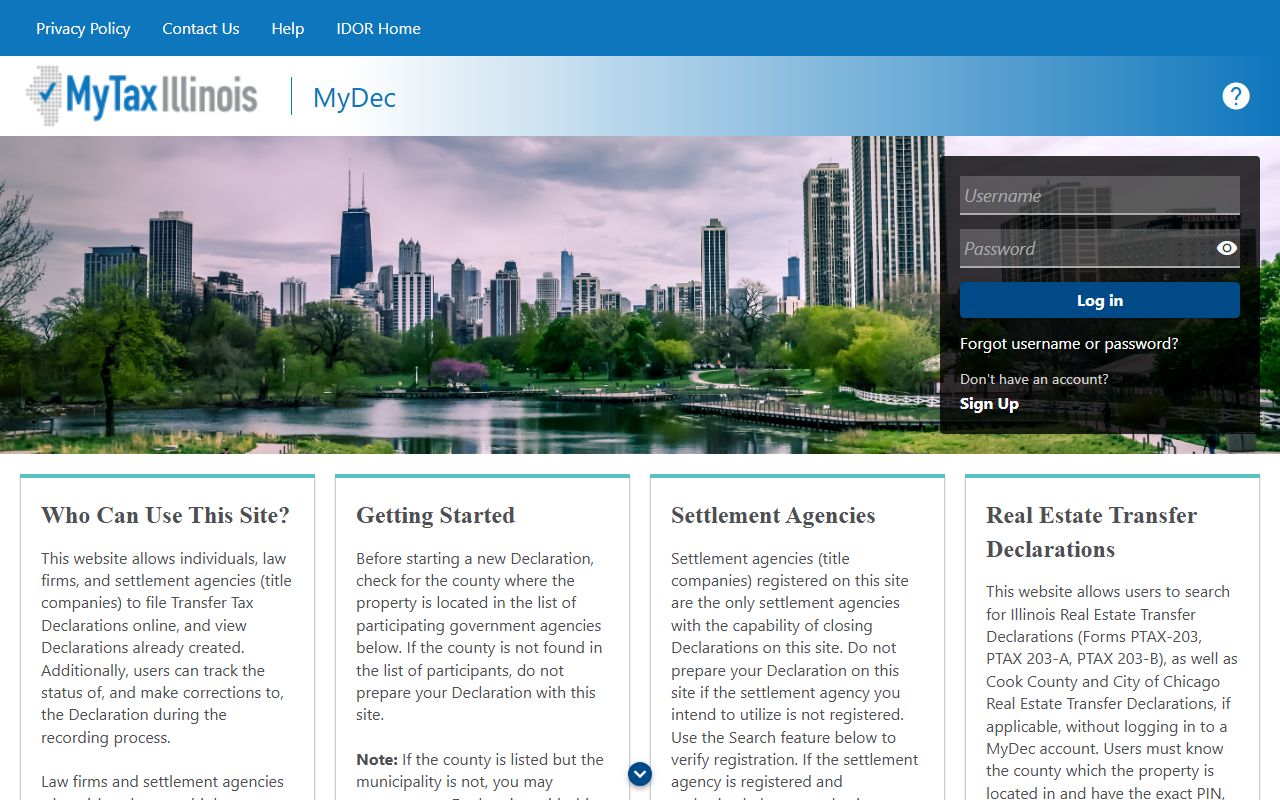
The MyDec portal is the starting point for most deed recordings involving a sale. Complete your declaration there before visiting the recorder's office or submitting documents through an eRecording service.
Electronic Recording in Fulton County
Illinois has authorized electronic recording of land documents under 765 ILCS 33, the Uniform Real Property Electronic Recording Act. Fulton County may accept eRecording submissions through approved vendors. Common platforms used across Illinois counties include Simplifile, CSC eRecording, EPN, Hopdox, and Indecomm. Contact the recorder's office directly to confirm which platforms Fulton County currently accepts and whether eRecording is available for the type of document you need to submit.
eRecording is most commonly used by title companies, lenders, and law firms that record high volumes of documents. For individual property owners recording a single deed, visiting the office in person or mailing the document remains a practical option. If you mail documents, include a self-addressed stamped envelope so the recorder can return the original to you after recording.
County Recorder Statutory Authority
The authority and duties of Illinois county recorders are set out in 55 ILCS 5/3-5018. This statute requires the recorder to accept and index all instruments entitled to be recorded, maintain those records in a permanent and accessible manner, and provide copies to the public upon request. The statute also spells out what information must appear on a document for it to be eligible for recording, and it sets out the basic fee structure that counties may charge.
Understanding the recorder's statutory role helps when you have a dispute about whether a document should have been recorded or indexed in a particular way. If the recorder's office declines to accept a document you submit, they are required to tell you the reason and return the instrument to you. In most cases, the issue is a missing element that can be corrected and resubmitted.
Below is a screenshot of the ILGA website showing the relevant section of 55 ILCS 5 that governs county recorder duties in Illinois. This is the controlling statute for Fulton County's recorder operations.
Source: Illinois General Assembly - 55 ILCS 5/3-5018
This statute is the legal foundation for the Fulton County Recorder's authority to accept, index, and provide access to deed records and other land instruments.
Military Discharge Records
Veterans should know that DD-214 military discharge records can often be recorded with the county recorder at no charge. Once recorded, the DD-214 becomes a public record that you or your survivors can request a copy of at any time. However, because DD-214s contain sensitive personal information, many counties restrict public access to recorded military records and provide copies only to the veteran or authorized family members. Contact the Fulton County Clerk and Recorder's office at (309) 547-3041 to ask about the process for recording and later retrieving a DD-214.
Requesting Copies of Recorded Deeds
Anyone can request a copy of a recorded deed in Fulton County. Plain copies are available for a fee per page. Certified copies, which bear the recorder's seal and certification language, cost more but may be required for legal proceedings, title work, or estate matters. To request copies by mail, send a written request to the recorder's office at 100 N. Main St., Lewistown, IL 61542, along with a check or money order for the applicable fees. Include the document number, recording date, or names of the parties if you know them.
If you are not sure what a document costs to copy, call the office at (309) 547-3041 before sending payment. Overpayment or underpayment will delay your request. Some counties now accept credit card payments by phone or online, so ask about available payment methods when you call.
Title companies and attorneys who need multiple copies for a closing may find it faster to work through a title plant or abstracting service that maintains its own index of Fulton County land records. These private services charge their own fees, but they can often produce copies faster than waiting for mail-in requests to be processed by the recorder's office.
Legal Aid and Free Help
If you need help understanding what a recorded deed means, how to correct an error, or how to file a deed on your own, free legal resources are available. Illinois Legal Aid Online provides guides and forms at illinoislegalaid.org. The site covers topics like how to file documents with the county recorder, what types of deeds exist, and when you might need an attorney. Prairie State Legal Services serves the Fulton County area and may be able to provide direct assistance to qualifying residents.
Nearby Counties
Deed records for neighboring counties are maintained by each county's respective clerk and recorder office. Links to nearby county pages are listed below.