
Find Deed Records in Peoria County
Peoria County deed records are managed by the Peoria County Clerk's Land Records Division, which records all property transfers, mortgages, and related land instruments filed in the county. You can search deed records online through the county portal, visit the office in person at the courthouse in Peoria, or submit documents electronically through the county's eRecording system.
Peoria County at a Glance
- County Seat: Peoria
- Population: 179,645
- Office: Peoria County Clerk - Land Records Division
- Address: 324 Main St., Room 101, Peoria, IL 61602
- Phone: (309) 672-6059
- Hours: Monday-Friday, 8:30 AM - 4:30 PM
- Website: peoriacounty.gov/243/e-Recording
Peoria County Clerk Land Records Division
The Peoria County Clerk's Land Records Division is the office that handles all deed records in the county. It is located at 324 Main St., Room 101, in downtown Peoria. The office records, indexes, and stores deeds, mortgages, liens, releases, plats, and other land instruments filed in Peoria County. Call (309) 672-6059 during business hours for questions about recording requirements or to check on a submitted document.
Office hours are Monday through Friday, 8:30 AM to 4:30 PM. The office is closed on all state and federal holidays. Walk-in visits are welcome during open hours. If you plan to record a document in person, arriving at least 30 minutes before closing gives the staff enough time to process your filing without rushing.
The Land Records Division also handles eRecording through the county's dedicated eRecording portal. The main page for that service is at peoriacounty.gov/243/e-Recording. This is also where you can find fee schedules and recording guidelines. Whether you are filing in person or electronically, reviewing the county's requirements before you submit will help avoid rejections.
The screenshot below shows the Peoria County eRecording information page, which covers how to submit deed documents electronically in the county.
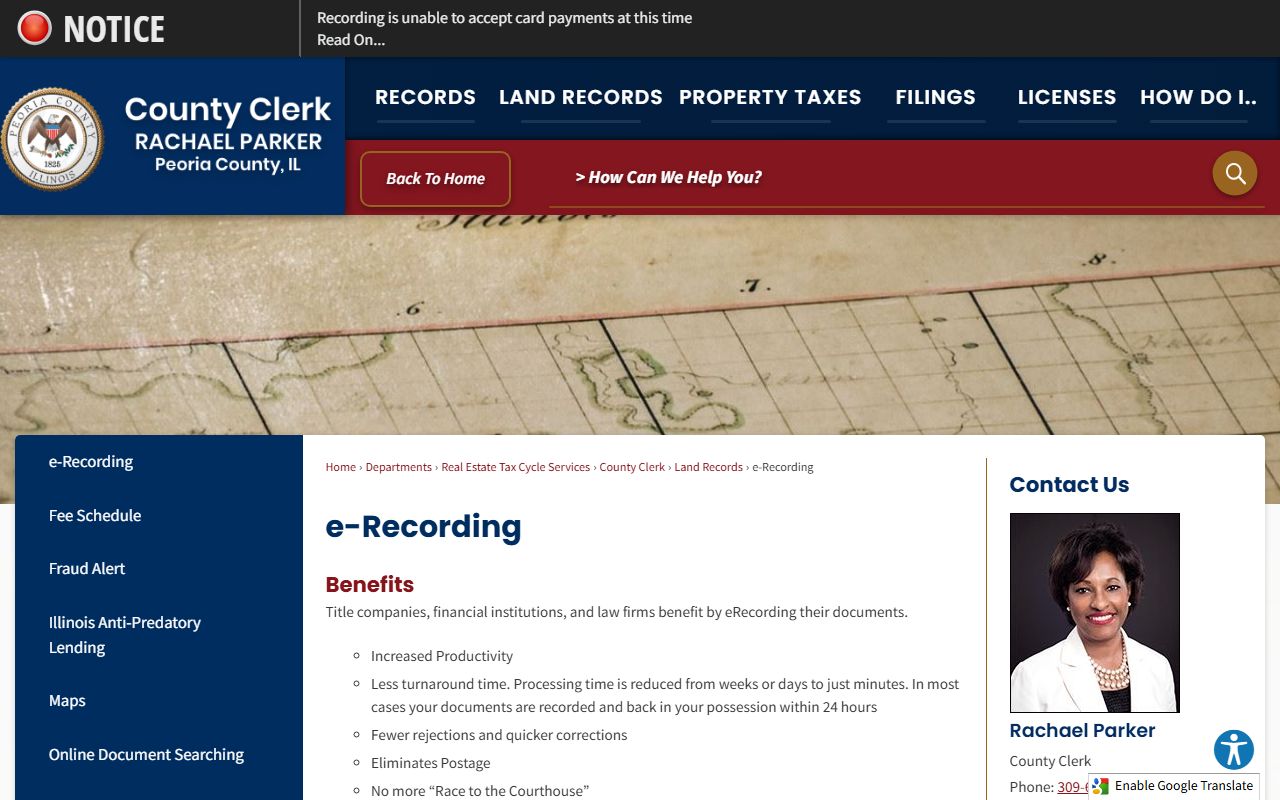
This page explains the eRecording process for Peoria County deed submissions, including which vendors are approved and how to get started with electronic filing.
Searching Peoria County Deed Records Online
Peoria County provides public online access to its land records. You can search by grantor name, grantee name, document type, or recording date. The portal is free to use and covers documents recorded over many years. Most property researchers start with a name or a date range, then narrow down from there once they see what the index returns.
The Illinois Conveyances Act, 765 ILCS 5, sets the standards for how deeds must be prepared and recorded across all Illinois counties. Under this law, a deed must be signed, notarized, and include both the grantee's mailing address and the Permanent Identification Number (PIN) of the parcel. Missing any of these elements will result in the document being returned unrecorded.
Some older Peoria County deed records may not be in the online system. Documents recorded before the county's digital index was built may only exist on microfilm or in paper form. For those, an in-person visit to the Land Records Division is the most reliable approach. Staff can pull microfilm records and make copies for you at the applicable copy fee.
If you need help understanding a document you find in the Peoria County deed index, Illinois Legal Aid has a free guide on working with county recorder offices at illinoislegalaid.org. For legal advice about title issues or property disputes, consult a licensed attorney who handles real property matters in Peoria County.
eRecording Deed Documents in Peoria County
Peoria County accepts electronic recording of deed documents under 765 ILCS 33, the Uniform Real Property Electronic Recording Act. This law authorizes Illinois counties to accept digitally submitted documents in place of paper filings. Peoria County uses this framework to allow attorneys, title companies, and lenders to submit deed documents without coming to the office in person.
Approved eRecording vendors for Peoria County include Simplifile, CSC, EPN, Hopdox, and Indecomm. Each vendor has its own platform and pricing structure, so compare them before you set up an account if you plan to file regularly. Once you are set up with a vendor, you can submit documents, track their status, and receive the recorded copy electronically without making a trip downtown.
eRecording is typically faster than in-person filing for straightforward documents. The system checks documents against formatting requirements before the county clerk reviews them. If a document has a problem, you find out quickly and can correct it without waiting in line again. This makes eRecording the preferred option for high-volume filers in Peoria County.
Not all document types are accepted electronically. Check the Peoria County eRecording page at peoriacounty.gov/243/e-Recording for the current list of accepted document types and any restrictions that apply to your specific filing. If a document does not qualify for eRecording, in-person filing at Room 101 is your option.
Recording Fees and Transfer Taxes
Recording fees in Peoria County are set under 55 ILCS 5/3-5018, the state statute that establishes the fee framework for all Illinois county recorders. Standard recording fees cover the first page and then add a per-page charge for each additional page. Confirm the exact amounts with the Land Records Division before submitting any document, since fees change from time to time.
Illinois charges a Real Estate Transfer Tax on deeds that involve a sale. The state rate under 35 ILCS 200 is $0.50 per $500 of the property's value. The county collects an additional $0.25 per $500 on top of the state rate. Both are due at recording and are collected by the Land Records Division on behalf of the state and county. These taxes are separate from the recording fee itself.
A Rental Housing Support Program (RHSP) surcharge of $18 applies to most recorded instruments in Peoria County. This statewide fee is added at the time of recording and helps fund housing assistance programs across Illinois. Veterans recording a DD-214 military discharge document are not charged a recording fee. That exemption is available at all recorder offices in Illinois.
Copies of recorded deed documents carry their own fees. Non-certified copies are cheaper than certified ones. A certified copy with the recorder's seal is required for most legal and financial purposes. A plain print works for personal reference. If you are not sure which type you need, tell the staff member what you plan to use the copy for and they can advise you.
Transfer Tax Forms and the PTAX-203
Every deed that involves a sale in Peoria County must be accompanied by a completed Real Estate Transfer Declaration. Illinois uses the PTAX-203 form for this requirement. You can complete the PTAX-203 online through the MyDec system at mytax.illinois.gov/MyDec. The system generates a confirmation number that you attach to your deed before submitting it to the Land Records Division.
The Illinois Department of Revenue provides step-by-step instructions for the PTAX-203 at tax.illinois.gov. These instructions explain every field on the form and clarify which transfers qualify for a transfer tax exemption. Gift transfers and certain family conveyances are commonly exempt, but you must claim the exemption correctly on the form.
Using MyDec speeds up the recording process. Instead of filling out a paper form at the counter, you complete everything online and bring a printed confirmation to your filing appointment. This reduces errors and gives the clerk's office what it needs to process your deed without delays. For eRecording users, the MyDec confirmation number attaches to the digital submission the same way it does for paper filings.
What Peoria County Deed Records Show
A deed recorded in Peoria County names the grantor and grantee, gives the legal description of the property, and states the date of transfer. The recording date and document number assigned by the Land Records Division become the permanent index references for that instrument. Many deeds also list the consideration paid, though some transfers state only a nominal dollar amount.
The Land Records Division also holds mortgages, mortgage releases, liens, easements, plats, and covenants. All of these form the broader land records system for Peoria County. A full search of a property's history usually requires looking at multiple document types, not just deeds. The online portal lets you search across document types at once.
Chain of title is the recorded sequence of ownership connecting one grantor to the next. Title companies examine the chain before a sale closes to spot gaps, errors, or unresolved encumbrances. A clean chain of title is essential for a smooth closing in Peoria County. Recording your deed right after closing is the first step in maintaining that chain for the next buyer.
Property Fraud Alert programs are available at some Illinois counties. These free services notify property owners when a document is recorded against their parcel. Contact the Peoria County Clerk's Land Records Division to ask whether a fraud alert service is currently available for Peoria County properties. It is worth a quick call to check.
Copies and Additional Resources
You can get copies of Peoria County deed records through the online portal, in person at 324 Main St., or by mail. The portal lets you view and print documents directly. For in-person requests, bring enough information to identify the document, such as the recording number, a name, or a date range. Mail requests should include the same details plus payment for the applicable copy fee.
Certified copies carry the recorder's official seal and are required for legal and financial transactions. Non-certified copies are less expensive and sufficient for personal reference. If you are not sure which type you need for a specific purpose, ask the staff or check with the party that requested the copy before you pay.
The Peoria County Assessor maintains separate property tax and assessment records. If you need assessed value information or ownership records for tax purposes, the Assessor's data is a good companion to what you find in the deed index. Both offices use the same PIN system, so cross-referencing between them is straightforward.
For legal help with title disputes, deed errors, or quiet title actions in Peoria County, contact Prairie State Legal Services or a local real estate attorney. Illinois Legal Aid at illinoislegalaid.org is also a free resource for general questions about recording and retrieving land documents in Illinois counties.
Cities in Peoria County
The following city in Peoria County has its own deed records page.
Nearby Counties
These counties border Peoria County and each maintains its own land records office.