
Find Deed Records in Marion County
Marion County deed records are kept by the Marion County Clerk & Recorder in Salem, Illinois, and form the official archive of every real estate ownership transfer, mortgage, lien, and easement recorded across the county's townships. Anyone searching Marion County deed records can find warranty deeds, quitclaim deeds, trustee deeds, and related instruments through the public index at the courthouse. Title companies, lenders, attorneys, estate administrators, and individual property owners use these records to confirm chain of title, check for encumbrances, and support real estate transactions of all sizes throughout central and southern Illinois.
Marion County at a Glance
- County Seat: Salem
- Population: 37,000
- Office: Marion County Clerk & Recorder
- Address: 100 E. Main St., Salem, IL 62881
- Phone: (618) 548-4146
- Hours: Monday-Friday, 8:00 AM - 4:30 PM
The Marion County Clerk & Recorder Office
The Marion County Clerk & Recorder operates out of the courthouse in Salem and handles both election administration and real estate recording. The recording division maintains the public index of all instruments affecting land in Marion County. Staff accept new documents for recording, issue certified copies, and provide public access to the index during regular business hours.
Salem sits near the center of a region where agriculture, mineral rights, and oil-related land transactions have historically generated significant deed activity. Oil production has been part of Marion County's economy for decades, and oil and gas leases, assignments, and release documents often appear alongside standard warranty deeds in the recorder's index. If you are researching a parcel with potential mineral interest history, the recorder's index is the right place to start.
Marion County borders Jefferson, Wayne, Clinton, Washington, Fayette, Effingham, Clay, and Richland counties. Land that spans county lines may have instruments in more than one recorder's office, so check all relevant counties when doing a full title search on a large parcel.
The image below shows the Illinois PTAX-203 instruction page from the Illinois Department of Revenue, which outlines how to complete the transfer declaration that must accompany a deed recorded in Marion County.
Source: Illinois PTAX-203 Instructions
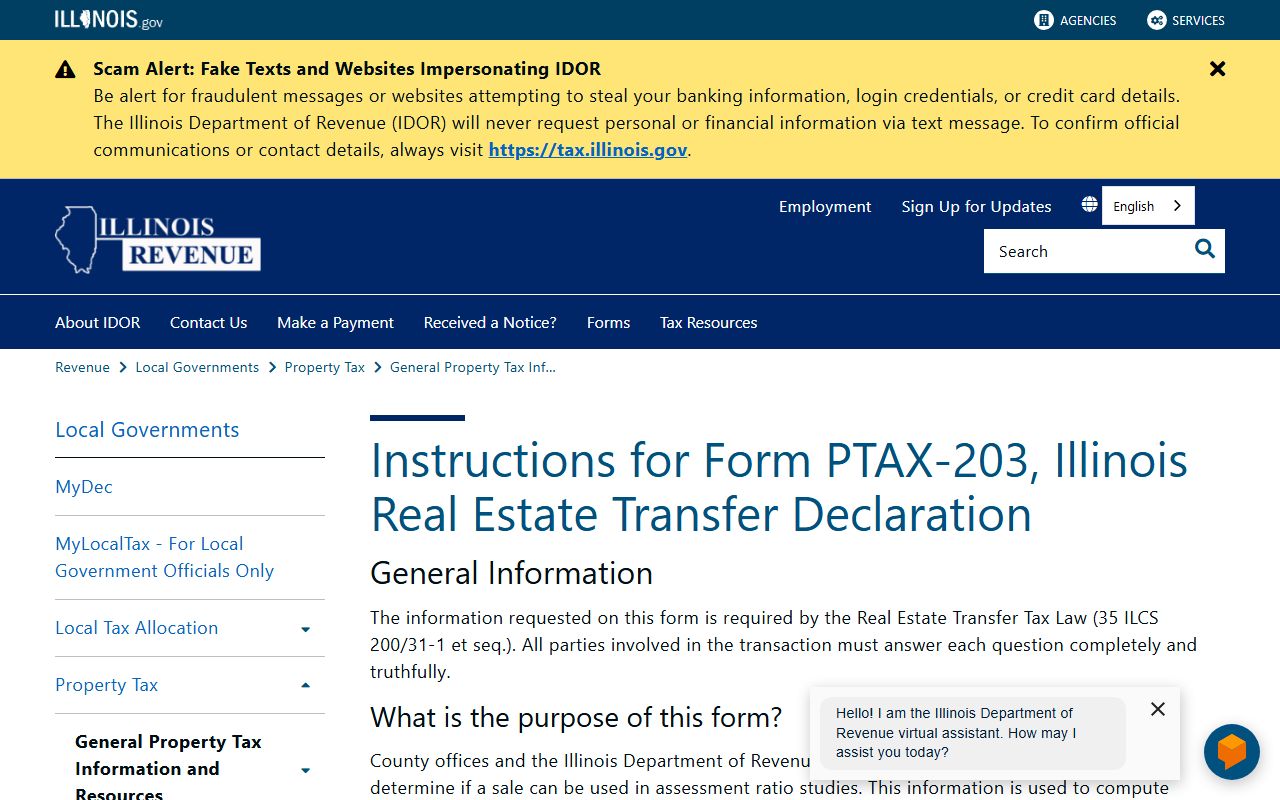
The PTAX-203 instruction page explains each line of the transfer declaration form, including which transactions are exempt from transfer tax and how to report consideration amounts. Reading this before you record saves time at the counter.
Searching Deed Records in Marion County
Public search access to the grantor-grantee index is free. Visit the Clerk/Recorder's office at 100 E. Main St. in Salem during business hours to use public terminals or work with bound volumes for older records. You can search by grantor name, grantee name, or property index number (PIN). For historical research going back several decades, some older instruments may be on microfilm or in paper ledger books.
When you find a document you need, you can request a copy at the counter. Certified copies carry the recorder's seal and are needed for legal filings, estate proceedings, and real estate closings. Uncertified copies are less expensive and work fine for personal reference or general research.
Out-of-area researchers can call (618) 548-4146 to ask about available online tools or mail-order copy procedures. The level of online access varies, so a quick call before planning a trip to Salem is always a good idea.
Illinois Recording Requirements
Deed recording requirements in Illinois are set by 765 ILCS 5, the Conveyances Act. The Marion County Clerk/Recorder enforces these requirements uniformly. A document that does not meet the standards will be returned without recording.
Every deed submitted for recording in Marion County must include:
- Grantor's notarized signature
- Notary's printed name and commission expiration date
- Property Index Number (PIN) on the document face
- Full legal description of the property
- Grantee's name and mailing address
- Preparer's name and address
- A blank 3-inch by 5-inch space in the upper right corner of page one for the recorder's stamp
The office does not provide legal advice or correct deficient documents. Have a real estate attorney or title company review your deed before submission if you are unsure whether it meets all requirements.
Recording Fees and Transfer Taxes
Marion County recording fees are set by 55 ILCS 5/3-5018. The base rate covers the first page; each additional page is less. Call (618) 548-4146 for the current fee schedule since rates can change with legislative updates.
Real estate transfer taxes apply to most deed transfers under 35 ILCS 200. The state transfer tax is $0.50 per $500 of consideration or fraction thereof. Marion County adds its own $0.25 per $500. Both taxes are collected at recording. Some transfers are exempt under specific statutory criteria, but a transfer declaration is still required even for exempt transactions.
An $18 Rental Housing Support Program (RHSP) surcharge applies to most recorded documents. This per-document fee funds a statewide affordable housing program. It is not a per-page charge, so whether your deed is two pages or ten, the RHSP surcharge is $18.
Transfer Declarations
Illinois requires a Real Estate Transfer Declaration for nearly every deed transfer. You can complete it using the state's online MyDec portal or, where still accepted, the paper PTAX-203 form. MyDec is the preferred method in most counties now. You enter the transaction details online, print the completed declaration, and bring it to the recorder's office with your deed.
If the transfer is exempt from tax (a gift, a corporate name change, an inheritance), you still file the declaration. Mark the exemption code and describe the reason. Failing to file or filing an incomplete declaration can trigger a follow-up from the Illinois Department of Revenue and may hold up the recording.
The PTAX-203 instructions page from the Department of Revenue explains exemption codes, how to calculate consideration, and what supplemental forms may apply to certain types of transfers like transfers into trust or estate deeds.
eRecording in Marion County
Illinois allows counties to accept deeds electronically under 765 ILCS 33. Approved eRecording vendors for Illinois include Simplifile, CSC, EPN, Hopdox, and Indecomm. Title companies and law firms that regularly record in Marion County should call (618) 548-4146 to confirm which vendors are active and how to enroll.
eRecording cuts down on courier costs and mailing delays. Documents are submitted digitally, reviewed by the recorder's staff, stamped, and returned electronically. The recorded document image is typically available within one business day. For high-volume filers this can make a real difference in turnaround time.
The image below is from the Illinois Legal Aid recording guide, which explains the process for filing documents at county recorder offices across Illinois, including what to expect when recording a deed in Marion County.
Source: Illinois Legal Aid Recording Guide
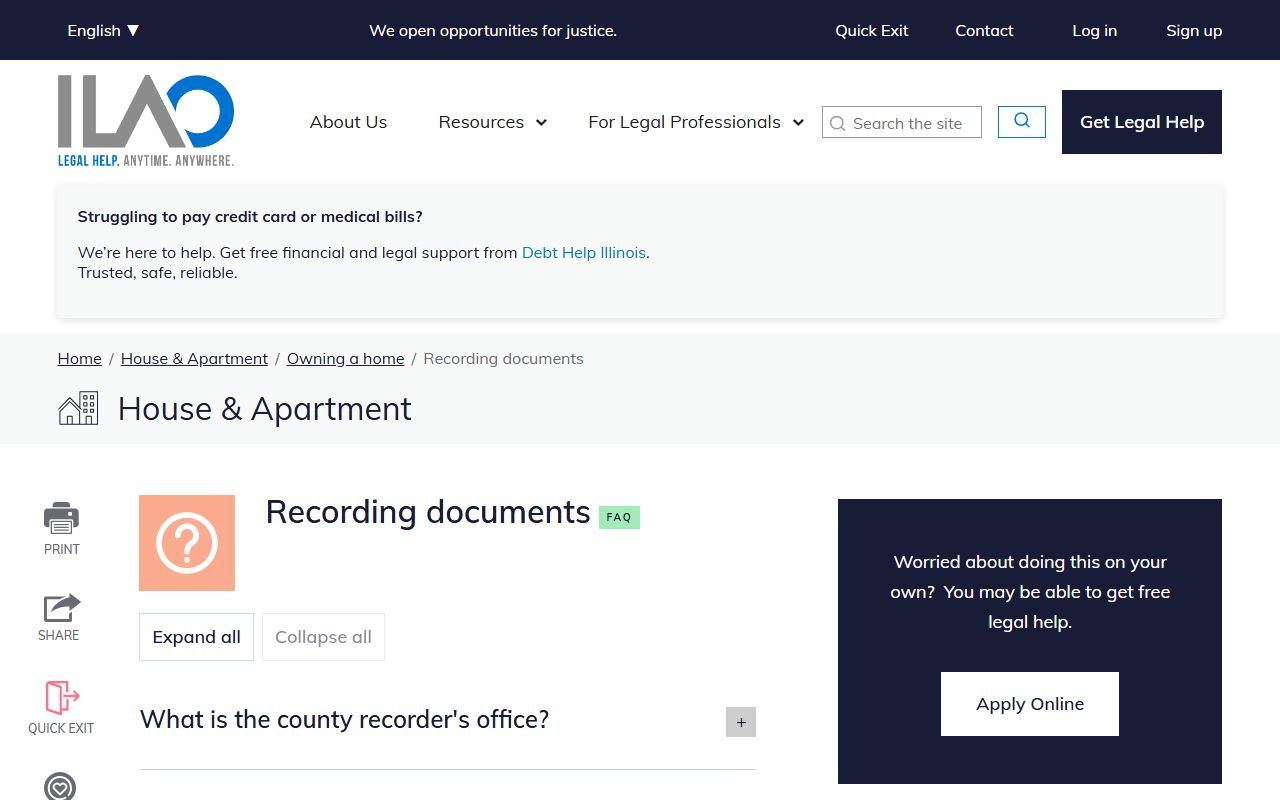
The Illinois Legal Aid guide is a useful plain-language overview of the recording process. It covers what types of documents get recorded, what the public can access, and how to get copies, which is helpful if you are new to searching deed records.
Types of Documents Recorded
The Marion County Clerk/Recorder indexes many instrument types beyond warranty deeds. A thorough title search should account for all of them.
- Warranty deeds and quitclaim deeds
- Trustee deeds and Illinois land trust documents
- Mortgages and mortgage releases
- Oil and gas leases, assignments, and releases
- Easements and right-of-way instruments
- Plats of subdivision
- Mechanics liens
- Lis pendens notices
- Foreclosure documents
- Installment sale contracts
- Memoranda of lease
- Conservation easements
- DD-214 military discharge records (often free for veterans)
Oil and gas leases deserve special attention in Marion County. Mineral rights are frequently severed from surface rights in this region, and a proper title search needs to track both surface ownership and any outstanding mineral leases or royalty interests separately.
Veterans: DD-214 Recording
Marion County records DD-214 military discharge papers for veterans at no charge. A recorded DD-214 gives veterans a secure official copy they can request anytime, useful for property tax exemptions, benefit claims, and replacing a lost original. The document is indexed but protected from general copying to preserve the veteran's personal information.
Nearby Counties
For border properties or large parcels that cross county lines, check the deed records in the adjoining county recorder offices as well as Marion County.