
Richland County Deed Records
Richland County deed records are filed and maintained by the Richland County Clerk and Recorder in Olney, Illinois. The office indexes all deeds, mortgages, liens, easements, and related instruments under state law, and this page covers how to record a deed, what to bring, what it costs, and how to search existing records.
Richland County at a Glance
- County Seat: Olney, IL 62450
- Population: 15,598
- Office: Richland County Clerk & Recorder
- Address: 103 W. Main St., Olney, IL 62450
- Phone: (618) 392-3111
- Hours: Monday-Friday, 8:00 AM - 4:30 PM
Recording Deeds in Richland County
The Richland County Clerk and Recorder sits at 103 W. Main St. in Olney. This office handles all real property recordings for the county under 765 ILCS 5, the Illinois Conveyances Act. When you record a deed, you create a public record of the transfer. That protects the new owner against later claims from parties who had no notice of the sale.
Recording is not optional if you want full legal protection. An unrecorded deed may still be valid between the parties, but it does nothing to protect you from a later buyer or lender who recorded first. File it as soon as possible after closing.
What You Need to Bring
The recorder checks your document at the counter before accepting it. Missing items mean rejection. Review this list before you drive to Olney.
Notarized signatures. Every grantor must sign in front of a notary public. The notary acknowledgment and seal must appear on the deed itself. No notarization means the deed cannot be recorded.
Property Index Number. Every parcel involved in the transfer needs its PIN listed on the deed. Get it from your tax bill or from the Richland County Assessor. This is required under 55 ILCS 5/3-5018.
Recording space. Leave a blank 3-inch by 5-inch area in the upper right corner of the first page. The recorder's stamp goes there. If anything is printed in that space, the document gets rejected.
Return address. The recorder mails the stamped original back after filing. Write your address clearly on the document or on a cover sheet.
PTAX-203 or MyDec submission. Most transfers need a completed Illinois Real Estate Transfer Declaration. You can use the paper PTAX-203 form or submit electronically through the Illinois MyDec portal. Even if the transfer is exempt, you still need to complete the form with the correct exemption code.
MyDec and Electronic Transfer Declarations
The Illinois Department of Revenue runs the MyDec portal at mytax.illinois.gov/MyDec/. Buyers, sellers, and attorneys can create and submit transfer declarations online through this system. When your county participates, the portal generates a receipt that you bring to the recorder along with your deed.
The screenshot below shows the Illinois MyDec portal, where electronic transfer declarations are submitted for counties that have opted in:
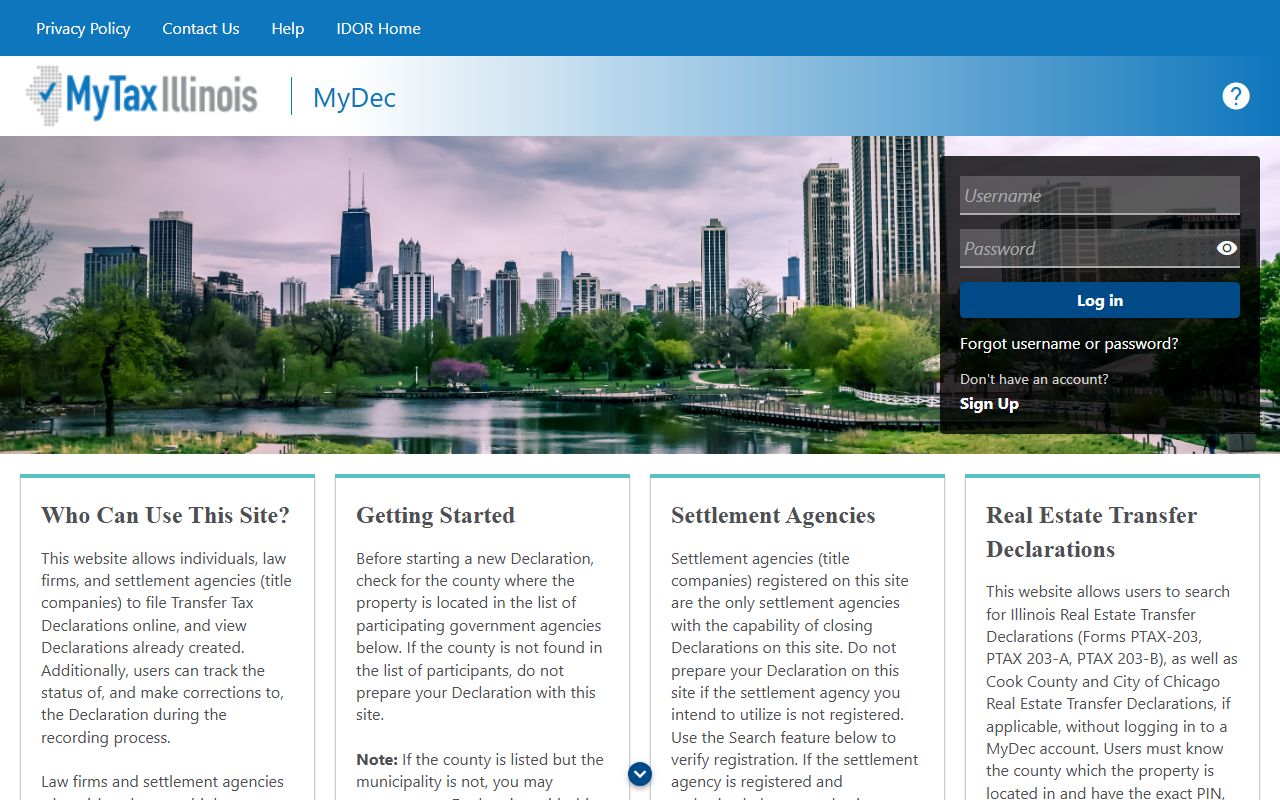
Check with the Richland County Recorder at (618) 392-3111 to confirm whether the county has opted in to MyDec. If it has not, use the paper PTAX-203 form from the Illinois Department of Revenue.
Fees and Transfer Taxes
Two costs come due when you record a deed in Richland County: the recording fee and the real estate transfer tax.
The state real estate transfer tax is $0.50 per $500 of consideration, or any fraction thereof. The county adds $0.25 per $500. On a $100,000 sale, the state tax is $100 and the county tax is $50, for a combined $150. The amount is based on the actual sale price reported on the PTAX-203.
Recording fees are charged per page as set in 55 ILCS 5/3-5018. On top of the per-page fee, every recorded document carries an $18 Rental Housing Support Program (RHSP) surcharge. Call (618) 392-3111 to confirm the current per-page amount and calculate your total before you go.
Veterans can record DD-214 military discharge documents at no cost. The recorder keeps a permanent certified copy. Any veteran who served in the U.S. armed forces can use this free service.
How to Record Your Deed
You have three ways to record a deed in Richland County.
In person. Bring the original notarized deed, your PTAX-203 or MyDec receipt, and payment to 103 W. Main St. in Olney. The clerk reviews the document, collects fees, stamps it, and usually returns it the same day.
By mail. Send the original deed, the completed transfer declaration, and a check or money order for the full amount. Include a self-addressed stamped envelope. Call ahead to confirm the exact fee. Short payment will hold up your recording.
eRecording. Illinois law under 765 ILCS 33 permits counties to accept electronically submitted documents. Services like Simplifile, CSC, EPN, Hopdox, and Indecomm connect title companies and attorneys directly to participating recorders. Ask the Richland County Recorder whether eRecording is active and which vendors are approved.
Searching the Grantor-Grantee Index
The recorder keeps a grantor-grantee index of every recorded instrument. You can search by the names of the parties or by parcel number. The index goes back to when the county began keeping records, though older documents may not be available digitally.
In-person searches are available at the Olney office during regular hours. Staff can assist with basic lookups. For a formal title search needed for a purchase or refinancing, a licensed title company or abstractor will give you the most reliable results. They can also issue title insurance, which protects against defects in the chain of title.
Some Illinois counties have online deed search portals. Call (618) 392-3111 or check the county website to find out whether Richland County offers remote record access. If an online portal exists, you can typically search by name or PIN and view scanned images of recorded documents. Older records may require an in-person visit.
Certified copies of any recorded instrument are available from the recorder's office. Courts, lenders, and government agencies often require certified copies rather than plain printouts. Request them in person or by mail with the correct fee.
Illinois Legal Aid Recording Guide
Illinois Legal Aid Online offers a plain-language guide to filing documents with county recorders. The screenshot below is from their recording information page at illinoislegalaid.org:
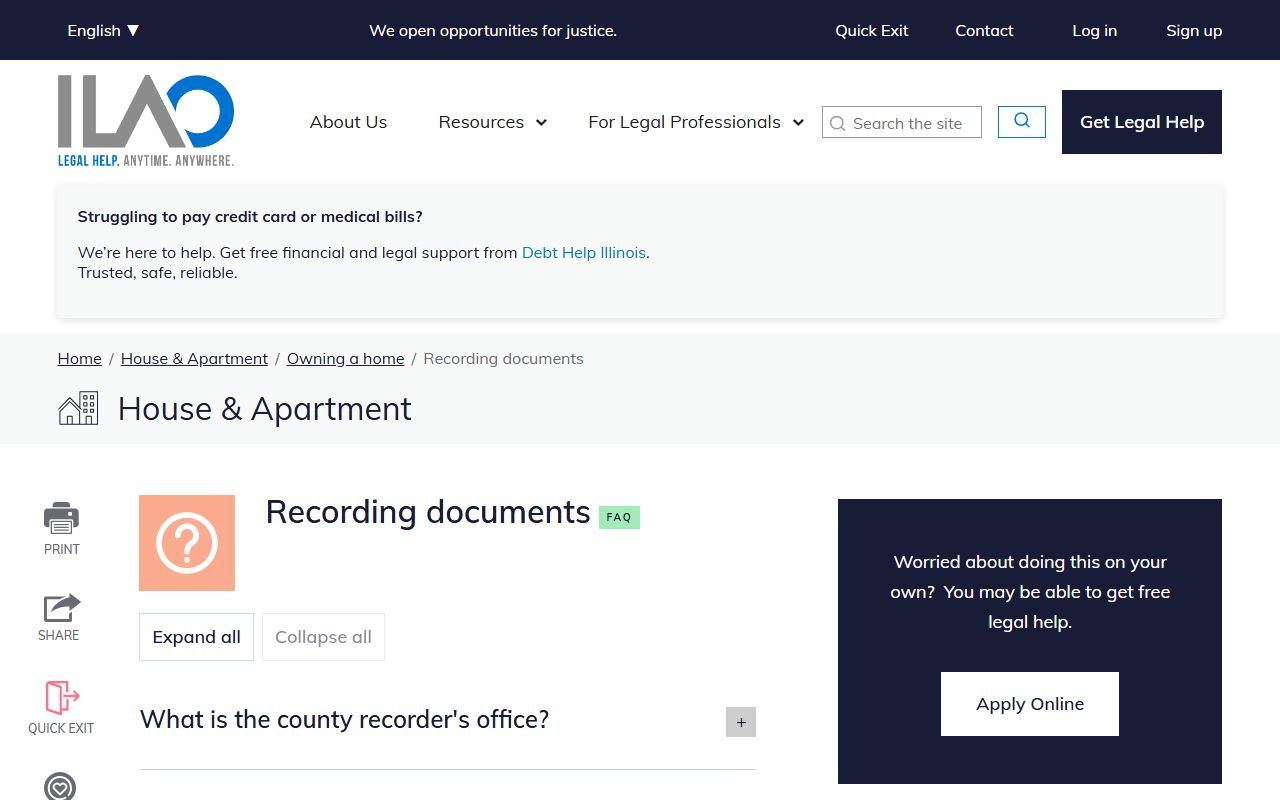
The guide covers what to bring, how fees are calculated, and what to do if the recorder rejects your document. It's a useful resource if you're filing on your own without an attorney or title company.
Post-Recording Steps
Once the deed is recorded and returned to you, keep the stamped original in a safe place. Then notify the Richland County Assessor so they can update ownership in the assessment roll. Tax bills go to whoever is listed in the assessor's records. If the assessor still shows the previous owner, tax bills will keep going to the wrong person.
Update your homeowner's insurance policy if you are the new owner. If a mortgage is involved, notify your lender once recording is complete. For questions about the PTAX-203 or transfer tax, contact the Illinois Department of Revenue.
Key Illinois Statutes
The core statutes governing deed recording in Richland County:
- 765 ILCS 5 - Conveyances Act. Sets the rules for how deeds must be prepared and recorded in Illinois.
- 55 ILCS 5/3-5018 - County recorder duties, indexing requirements, and the recording fee schedule.
- 35 ILCS 200 - Property Tax Code. Governs PINs, assessments, and how ownership is tracked after recording.
- 765 ILCS 33 - Electronic Commerce Security Act. The legal basis for eRecording in Illinois counties.
Where to Get Help
Contact the Richland County Clerk and Recorder directly at (618) 392-3111 with questions about the recording process or specific documents. For free legal information about recording, visit Illinois Legal Aid Online. If you have a title dispute or other legal issue involving property, the Illinois State Bar Association can help you find a licensed real estate attorney in the area.
Nearby Counties
Richland County is bordered by several other southeastern Illinois counties, each maintaining its own deed records at a local clerk and recorder's office.