
Access Wabash County Deed Records
Wabash County deed records are filed at the Wabash County Clerk and Recorder's office at 401 Market St. in Mount Carmel, Illinois. All property deeds, mortgages, liens, easements, and other land instruments for the county are indexed and stored here, and this page covers how to record a document, what the fees are, and how to search existing records.
Wabash County at a Glance
- County Seat: Mount Carmel, IL 62863
- Population: 11,119
- Office: Wabash County Clerk & Recorder
- Address: 401 Market St., Mount Carmel, IL 62863
- Phone: (618) 262-4561
- Hours: Monday-Friday, 8:00 AM - 4:30 PM
About the Wabash County Recorder
The Wabash County Clerk and Recorder is located at 401 Market St. in Mount Carmel, near the Indiana state line in southeastern Illinois. This office operates under 765 ILCS 5 and maintains the official public record of all real property transactions in Wabash County. Recording a deed here is what makes the transfer legal and effective against third parties who later try to claim an interest in the same property.
Wabash County is one of Illinois's smaller counties by population. Most closings involve local attorneys or title companies who handle the recording as part of the transaction. But individuals can also record documents directly at the office in Mount Carmel.
Preparing Your Deed for Recording
Illinois law and county procedures set several requirements that must be met before the recorder will accept a deed. Check each item before driving to Mount Carmel.
Notarized acknowledgment. Every grantor on the deed must sign in front of a notary. The notary seal and acknowledgment text must appear on the document itself. No notarization means rejection at the counter. There are no exceptions.
Property Index Number. Write the PIN for every parcel being transferred on the face of the deed. You can get PINs from the Wabash County Assessor or from a current property tax bill. This is required under 55 ILCS 5/3-5018.
3-by-5 stamp area. Keep a clear 3-inch by 5-inch area in the upper right corner of the first page. The recorder uses this space to stamp the recording data. Any text or markings in that area will cause rejection.
Return address. The recorder mails the stamped original back to you. Include a clear mailing address on the document or cover sheet.
PTAX-203. Most transfers in Illinois require a completed Real Estate Transfer Declaration (PTAX-203). This form goes to the Illinois Department of Revenue. Exempt transfers still require the form with the correct exemption code filled in. Submit it with the deed.
MyDec Electronic Declarations
The Illinois Department of Revenue's MyDec portal lets attorneys, title companies, and parties to a sale submit the PTAX-203 transfer declaration online instead of using a paper form. Where the county participates, the portal generates an electronic receipt that accompanies the deed to the recorder. Ask the Wabash County Recorder at (618) 262-4561 whether the county has opted in to MyDec.
The screenshot below shows the Illinois MyDec portal where electronic transfer declarations are submitted:
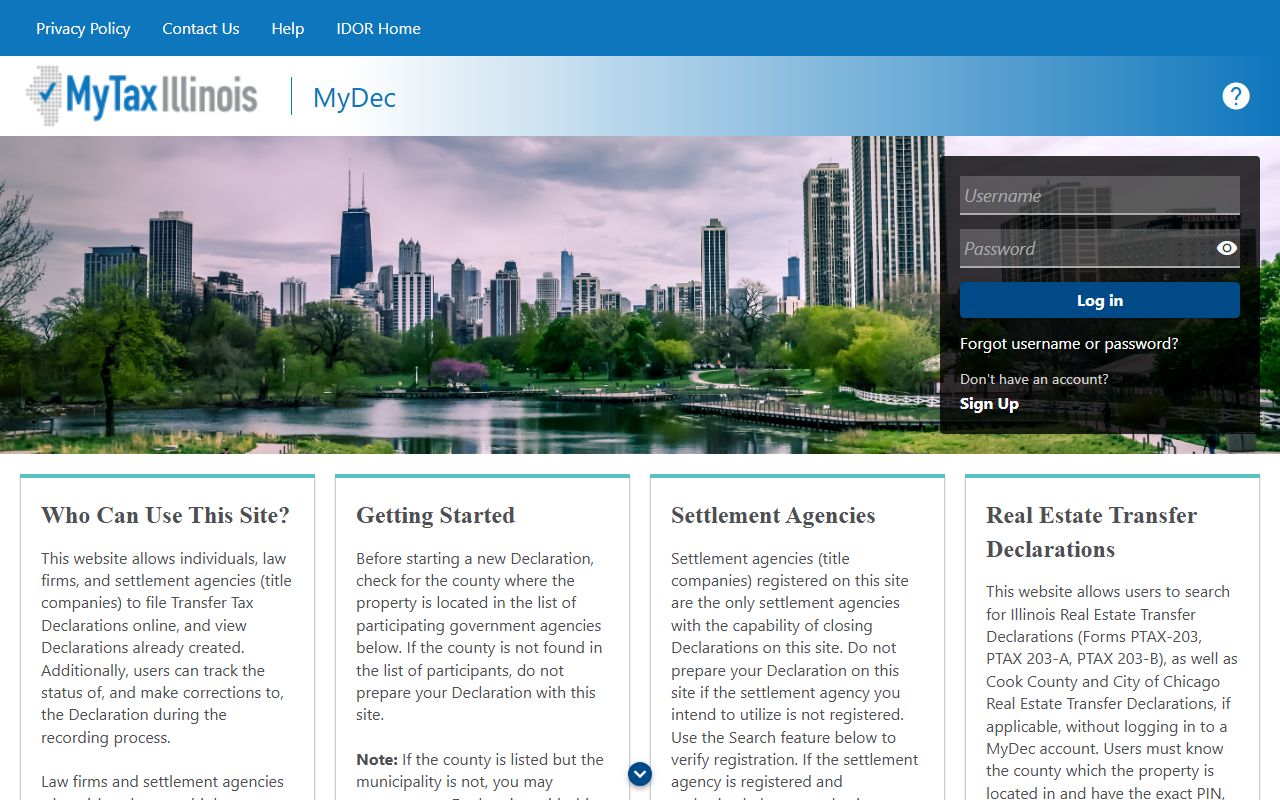
If Wabash County does not yet participate in MyDec, the paper PTAX-203 form is available through the Illinois Department of Revenue and must be submitted in paper with the deed.
Fees: Recording Charges and Transfer Taxes
When you record a deed in Wabash County, you pay two types of charges: recording fees and real estate transfer taxes.
The state real estate transfer tax is $0.50 per $500 of consideration, or any fraction of $500. The county adds $0.25 per $500. On an $80,000 sale, that's $80 to the state and $40 to the county, totaling $120. The sale price comes from the PTAX-203.
Per-page recording fees are set by 55 ILCS 5/3-5018. Every document also carries a flat $18 Rental Housing Support Program surcharge. Call (618) 262-4561 before you go to confirm the current per-page rate and to calculate the exact total you'll owe. Underpayment will hold up your recording.
Veterans can record DD-214 military discharge documents at no charge. The recorder keeps a certified copy on permanent file. Wabash County veterans who need proof of service for benefits, tax exemptions, or other purposes should bring their original DD-214 to the office in Mount Carmel.
Ways to Record a Deed
There are three ways to get a deed recorded with the Wabash County Recorder.
In person. This is the most reliable method. Bring the original notarized deed, your PTAX-203 or MyDec receipt, and payment to 401 Market St. in Mount Carmel. The recorder reviews the document, stamps it, collects fees, and typically returns the original the same day.
By mail. Mail the original deed, completed transfer declaration, and a check or money order for the total amount. Include a self-addressed stamped envelope. Call first to confirm the exact fee. Documents sent with short payment will be held until you cover the difference.
eRecording. 765 ILCS 33 authorizes Illinois counties to accept electronically submitted documents from approved vendors. Call the Wabash County Recorder to find out whether eRecording is active and which vendors are approved. Services like Simplifile, CSC, EPN, Hopdox, and Indecomm are used widely across Illinois. eRecording cuts delivery and processing time significantly for title companies and attorneys handling multiple closings.
How the Grantor-Grantee Index Works
Every instrument recorded in Wabash County is indexed in the grantor-grantee index. You can look up documents by the name of the grantor (the person transferring the property), the name of the grantee (the person receiving it), or by PIN. The index provides the book and page reference or document number needed to pull a copy of the original instrument.
In-person searches are available at the Mount Carmel office. Staff can assist with basic lookups. For a complete title search, a licensed title company or abstractor who works in Wabash County is the right choice. They can search back decades, spot issues like unreleased mortgages or judgment liens, and issue title insurance. That insurance protects you if a problem is discovered later.
Call (618) 262-4561 to ask whether Wabash County has an online deed search portal. If one is available, you can typically search by name or PIN and view scanned document images without making an in-person trip. Older records may require visiting the office.
Certified copies of recorded instruments can be requested in person or by mail. Courts, lenders, and agencies require certified copies bearing the county seal. Include a written request and payment when ordering by mail.
35 ILCS 200 and the Property Tax Code
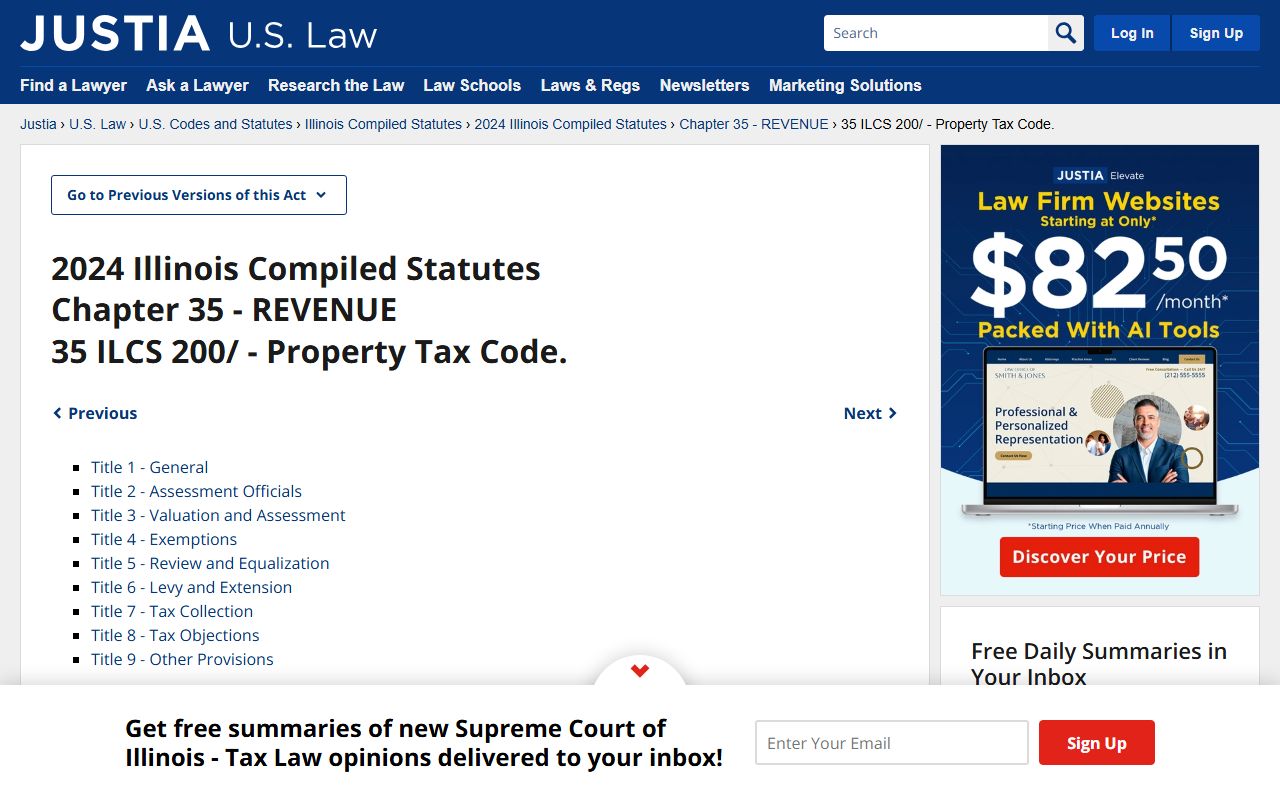
The Illinois Property Tax Code at 35 ILCS 200 is relevant to deed recording because it governs how property parcels are identified, assessed, and taxed after a transfer. The screenshot below shows the statute page:
After your deed is recorded, the Wabash County Assessor needs to know about the transfer so they can update the ownership record. Tax bills go to whoever is listed in the assessor's files. If the assessor isn't notified, property taxes can keep billing to the prior owner long after the sale is complete.
Key Statutes
The main Illinois laws governing deed recording in Wabash County:
- 765 ILCS 5 - Conveyances Act. Governs execution, acknowledgment, and recording of deeds in Illinois.
- 55 ILCS 5/3-5018 - County recorder authority and fee schedule.
- 35 ILCS 200 - Property Tax Code. Governs PINs, assessment, and ownership records after recording.
- 765 ILCS 33 - Electronic Commerce Security Act. Authorizes eRecording in Illinois.
Help and Resources
Call the Wabash County Clerk and Recorder at (618) 262-4561 for questions about a specific document or the recording process. For free plain-language guidance, visit Illinois Legal Aid Online. Their articles cover what to bring, how fees are calculated, and how to respond to a rejection. For title disputes or more complex property law questions, the Illinois State Bar Association can connect you with a licensed real estate attorney in the southeastern Illinois area.
Nearby Counties
Wabash County is located in far southeastern Illinois and borders counties in both Illinois and Indiana, each with its own recorder's office.