
Search Mercer County Deed Records
Mercer County deed records are kept by the Mercer County Clerk and Recorder in Aledo, Illinois. The office handles all property transfers, mortgages, releases, and related land documents for the county. This page explains how to record a document, what you need to bring, what fees to expect, and how to search existing records.
Mercer County at a Glance
- County Seat: Aledo
- Population: 15,495
- Office: Mercer County Clerk & Recorder
- Address: 100 SE 3rd St., Aledo, IL 61231
- Phone: (309) 582-7021
- Hours: Monday-Friday, 8:00 AM - 4:30 PM
The Mercer County Recorder's Office
The Mercer County Clerk and Recorder's office is located at 100 SE 3rd St. in Aledo. This is where all deed recordings for Mercer County are filed and indexed. The office operates under 765 ILCS 5, Illinois's Conveyances Act, which sets the legal framework for how deeds must be prepared and filed. Staff can answer basic questions about recording requirements, though they can't give legal advice.
Mercer County sits in western Illinois along the Iowa border, between Rock Island County to the north and Warren County to the south. Most real estate activity in the county runs through Aledo. If you're buying or selling property anywhere in Mercer County, your deed will be filed here.
What You Must Have to Record a Deed
Several requirements apply to every deed recorded in Mercer County. Missing any one of them will cause the recorder to reject your document. It's worth reviewing this list before you show up at the counter or put anything in the mail.
Notarized signature. The grantor (seller) must sign the deed in front of a notary. The notary acknowledgment must appear on the document itself. Electronic notarization is allowed under Illinois law in some circumstances, but confirm with the recorder's office whether they accept it.
Property Index Number. Every deed must include the PIN for each parcel. The PIN comes from the county assessor and connects the deed to the right property in the tax records. This requirement is set by 55 ILCS 5/3-5018.
3-inch by 5-inch blank space. Leave a clear area in the upper right corner of the first page. The recorder uses that space for the recording stamp. If you're using a preprinted form, check that the form is formatted correctly.
Return address. Include a mailing address so the office can return the document after recording.
PTAX-203 form. Nearly all property transfers in Illinois require this Illinois Real Estate Transfer Declaration. You file it at the same time as the deed. Exempt transactions still need the form; you just check the applicable exemption box. The form reports the sale price to the state and county for tax and statistical purposes.
Transfer Taxes and Recording Fees
Illinois imposes a real estate transfer tax on most property sales. The state takes $0.50 per $500 of consideration. Mercer County adds $0.25 per $500. On a $150,000 sale, the state portion is $150 and the county portion is $75, for a total of $225. These are paid at the time of recording, not at closing (though in practice many closings handle the payment before the deed reaches the recorder).
The recording fee itself covers the cost of processing and indexing the document. The base recording fee is set under 55 ILCS 5/3-5018 and typically runs per page. There is also a flat Rental Housing Support Program surcharge of $18 per document, regardless of page count. Call (309) 582-7021 for the current fee schedule before recording.
Veterans recording a DD-214 military discharge certificate pay no fee. The recorder keeps a certified copy on file, which can be useful for benefit applications and other veteran services.
Illinois Department of Revenue PTAX-203 Instructions
The Illinois Department of Revenue provides detailed guidance on completing the PTAX-203 transfer declaration. The instructions page covers which transfers are taxable, which are exempt, and how to fill out each section of the form correctly.
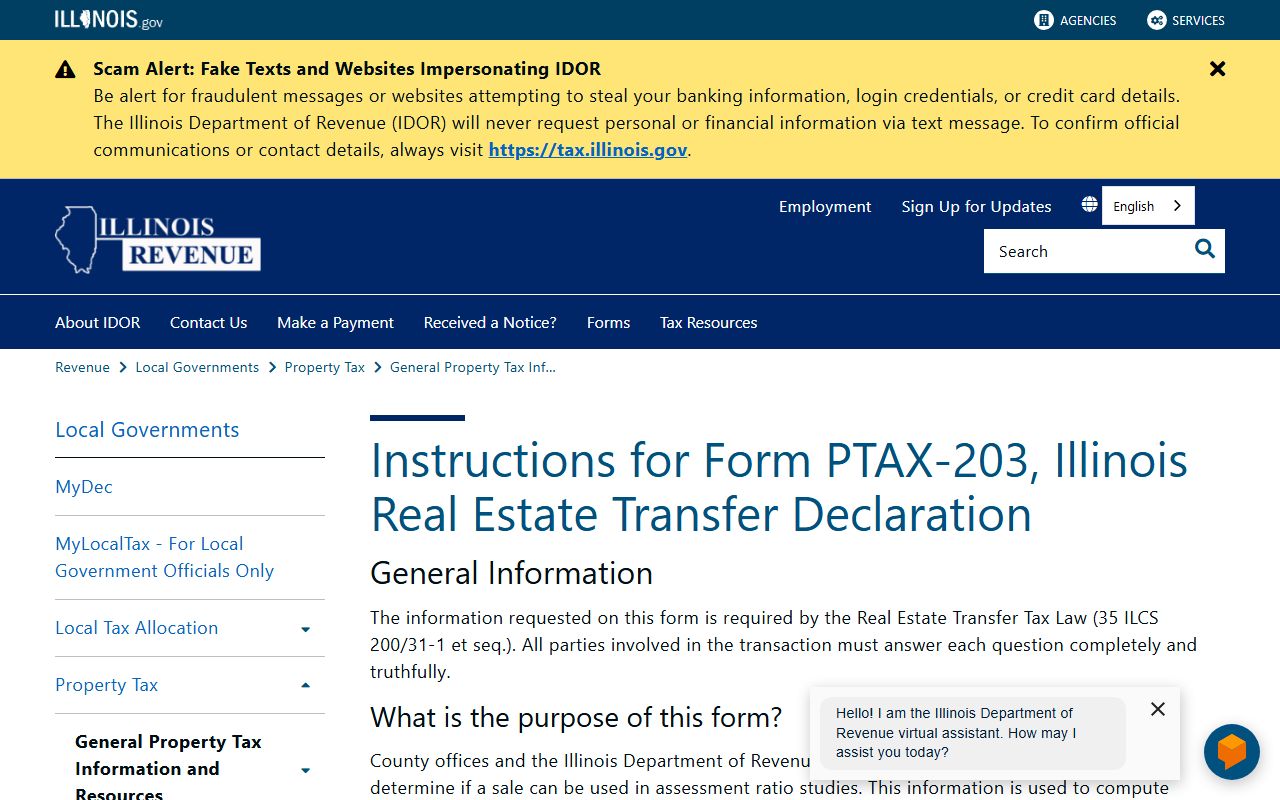
You can access the PTAX-203 instructions directly at tax.illinois.gov. Print the form, complete it at or before closing, and bring it with you to the recorder's office when you file the deed.
How to Record in Mercer County
You have three main options for recording a deed in Mercer County: in person, by mail, or (if available) electronically.
In person. Bring your original signed and notarized deed, completed PTAX-203, and payment to 100 SE 3rd St. in Aledo. The recorder will stamp the document, collect fees, and give you back the original. This is the most reliable method and lets you catch any issues on the spot.
By mail. Send the original deed, the completed PTAX-203, and a check or money order for the recording fees plus transfer taxes to the recorder's address. Include a self-addressed stamped envelope for the return of your recorded document. Call first to confirm the exact fee amount so your payment doesn't fall short.
eRecording. Some Illinois recorders accept electronic document submission through platforms like Simplifile, CSC, EPN, Hopdox, or Indecomm. Contact the Mercer County Recorder at (309) 582-7021 to ask whether they currently accept eRecording and which providers are approved. eRecording speeds up the process considerably for title companies handling multiple transactions.
Searching Deed Records
The recorder maintains a grantor-grantee index of all recorded documents. You can search in person at the office in Aledo. Staff can help you look up documents by party name or legal description. For historical records, especially those predating the office's electronic records, an in-person visit or a request for a staff search may be necessary.
Some Illinois counties have put their deed indexes online. Check whether Mercer County has a public web portal by visiting the county's official website or calling (309) 582-7021. If online access is available, you can search from home by grantor or grantee name or by parcel identification number.
Certified copies of recorded documents are available from the recorder's office for a per-page fee. These are official copies with the county seal and are accepted by courts, title companies, and government agencies. If you just need a plain copy for your own reference, that usually costs less.
For a formal title search, most buyers work with a title insurance company or a licensed abstractor. They have access to historical records and know how to spot potential problems like old liens, gaps in the chain of title, or easements that don't show up on a basic deed search.
35 ILCS 200 and Property Tax Records
The Illinois Property Tax Code, found at 35 ILCS 200, governs how property is assessed and taxed in Illinois. It also controls how the PIN system works and how property transfers affect tax records. When you record a deed in Mercer County, the information flows to the county assessor's office, which updates ownership records for tax billing.
New owners should follow up with the Mercer County Assessor to confirm that ownership records have been updated after recording. Tax bills will continue to go to the prior owner until the assessor's records are changed. You can review the full statute at law.justia.com.
Legal Framework
The key Illinois statutes covering deed recording in Mercer County are:
- 765 ILCS 5 - Conveyances Act. Governs how deeds must be signed, acknowledged, and recorded.
- 55 ILCS 5/3-5018 - County recorder authority, duties, and fee schedule.
- 35 ILCS 200 - Property Tax Code, including PIN requirements and transfer reporting.
- 765 ILCS 33 - Electronic Commerce Security Act, which enables eRecording in Illinois.
Help and Legal Aid
If you need help understanding the recording process and can't afford an attorney, Illinois Legal Aid Online has free guides on how to file documents with county recorders. These cover the basics of deed recording, what forms are required, and how to handle common problems.
For legal disputes involving property, boundaries, or title claims, consult a licensed Illinois real estate attorney. The Mercer County area is served by attorneys in Aledo and the surrounding region. The Illinois State Bar Association offers a lawyer referral service if you need help finding someone.
Nearby Counties
Mercer County is surrounded by several other Illinois counties. Each has its own recorder's office for property documents.