
Deed Records in Williamson County
Williamson County deed records are filed at the Williamson County Clerk and Recorder in Marion, Illinois, where the office maintains the permanent public archive of every property deed, mortgage, lien, and land instrument recorded in the county. Anyone searching deed records in Williamson County, whether for a title review, a real estate purchase, or an ownership question, can access the public index at the Marion courthouse during regular business hours or submit a mail request.
Williamson County Deed Records Quick Facts
Williamson County Clerk and Recorder Office
The Williamson County Clerk and Recorder is at 200 W. Jefferson St., Marion, IL 62959. Phone is (618) 997-1301. Hours are Monday through Friday. The county combines Clerk and Recorder duties under one roof, so county administrative records and property deed records all pass through the same office in Marion.
Each deed that comes in gets a recording date and a document number. That number is the key to the grantor and grantee name index, which is where any researcher starts when tracing ownership. The index is open to the public at no charge during office hours. No appointment is needed to search it. You can look up every instrument ever recorded against a given owner's name or a specific parcel.
The office archives warranty deeds, quitclaim deeds, trustee's deeds, mortgages, releases, mechanic's liens, judgment liens, easements, subdivision plats, and survey documents. They check each document for basic compliance, stamp it, index it, and store it. Staff can help you navigate the index but do not search on your behalf and do not provide legal advice about what any recorded instrument means for your situation.
The Illinois MyDec portal, shown below from mytax.illinois.gov, is where parties to a Williamson County property sale complete the state-required PTAX-203 transfer declaration before bringing their deed to the Marion office for recording.
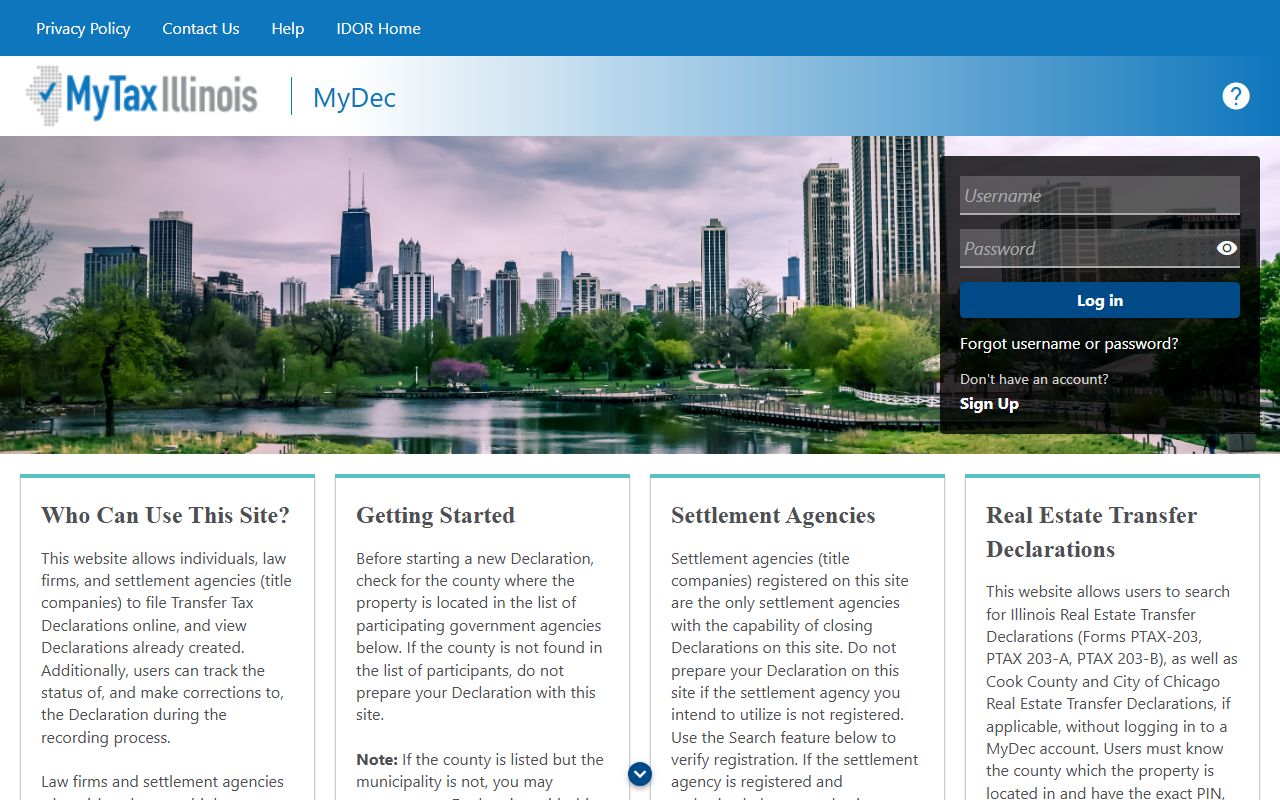
Once the PTAX-203 is submitted through MyDec, the system produces a printed barcode confirmation. You bring that barcode to 200 W. Jefferson St. along with the deed. Without it, a taxable transfer will not move forward at the counter in Marion.
What a Deed Must Have to Record in Williamson County
The Illinois Conveyances Act at 765 ILCS 5 sets the floor for every deed recorded in the state. A deed must name a grantor and a grantee, describe the property with a full legal description, and carry a notarized acknowledgment. If any piece is missing, the Recorder's Office in Marion will reject the document and hand it back without recording it.
Documents must also include the parcel identification number for the property being transferred. The PIN is usually placed near the legal description or at the top of the first page. The deed also needs a blank 3-inch by 5-inch space in the upper right corner of the first page. That is where the Recorder stamps the recording date, document number, and other indexing data. Covering that space or failing to leave it clear results in rejection.
Most taxable Williamson County transfers also require the PTAX-203 to travel with the deed. The Illinois Department of Revenue's instructions for the form are at tax.illinois.gov. Some transfers are exempt, such as gifts, court-ordered transfers, and certain government conveyances. Even an exempt transfer needs the PTAX-203 with the exemption code filled in. Call (618) 997-1301 if you are not sure whether your transaction requires the form.
Transfer Taxes and Recording Fees
Illinois imposes a real estate transfer tax on most deed conveyances under 35 ILCS 200. The state rate is $0.50 per $500 of consideration. Williamson County adds $0.25 per $500. On a $180,000 sale in the Marion area, the state tax is $180 and the county adds $90, making the combined transfer tax $270. That amount can climb higher if a municipality like Marion levies its own local transfer tax on top. Stamps go on the deed at recording.
Recording fees for Williamson County documents are set under 55 ILCS 5/3-5018. That statute caps what county recorders across Illinois can charge per page and for other services. Call (618) 997-1301 or stop by 200 W. Jefferson St. to confirm current rates before you submit documents for recording.
Every instrument recorded in Illinois carries a mandatory $18 RHSP surcharge. The Rental Housing Support Program fee is per document, not per page, and is not reduced based on sale price or document length. It is collected when you file the deed in Marion, on top of the base recording fee and any transfer tax owed.
Veterans can record DD-214 military discharge documents at the Williamson County office at no charge. Certified copies of DD-214 records are also available to qualifying veterans and their families at low or no cost. Contact the Marion office for current policy on these fee waivers.
How to Search Deed Records in Williamson County
Walk-in access to the public index at 200 W. Jefferson St. in Marion is available Monday through Friday during office hours. The grantor and grantee name index is the starting point. Bring the full name of a current or prior owner, a parcel ID number, or the property address. Staff point you to the right index, then the search is yours to run. There is no charge to view the index.
Once you identify specific documents you want copies of, the office can make them for a per-page fee set under 55 ILCS 5/3-5018. Certified copies cost a bit more than plain copies. If you are building a chain of title that runs back 40 or more years, plan to spend time working through both the grantor and grantee indexes for each link in the chain.
Mail requests are accepted at 200 W. Jefferson St., Marion, IL 62959. Write down the party names, approximate recording year or date range, and any document numbers you have. Include payment by check or money order for the expected copy fee. The office will search and mail results back to you. That process takes longer than an in-person visit, so if timing matters, go in person.
Illinois follows a race-notice recording system. The first buyer to record who had no prior knowledge of a competing unrecorded claim generally holds the stronger title. Recording promptly after a Williamson County closing is not optional if you want full legal protection for your ownership.
Electronic Recording in Williamson County
Under 765 ILCS 33, the Illinois Electronic Recording Act, county recorders are authorized to accept deeds and other instruments submitted digitally through approved vendor platforms. When eRecording is active, a title company or lender sends the deed file through a platform like Simplifile, CSC, EPN, Hopdox, or Indecomm, and the Williamson County Recorder processes it and returns a stamped copy through the same system. No trip to Marion is needed.
Call (618) 997-1301 to confirm whether eRecording is currently available at the Williamson County Clerk and Recorder and which vendor platforms are accepted. For individual buyers and sellers who are not set up with a vendor system, delivering the signed, notarized deed and PTAX-203 confirmation to the counter at 200 W. Jefferson St. is the standard path and works fine for one-time recordings.
Documents Held in the Williamson County Archive
The permanent Williamson County deed archive holds far more than warranty deeds. The full record set includes quitclaim deeds, trustee's deeds, sheriff's deeds from foreclosure and tax sales, land trust memoranda, mortgages and trust deeds, mortgage satisfactions, partial releases, mechanic's liens and lien releases, UCC financing statements tied to real property, judgment liens and releases, easements, right-of-way documents, subdivision plat maps, survey documents, and DD-214 military discharge records. Each gets a document number and appears in the name index under both parties to the transaction.
Illinois Legal Aid Online, shown below from illinoislegalaid.org, has a free guide written for people handling a deed recording in an Illinois county recorder office without a title company or attorney doing it for them.
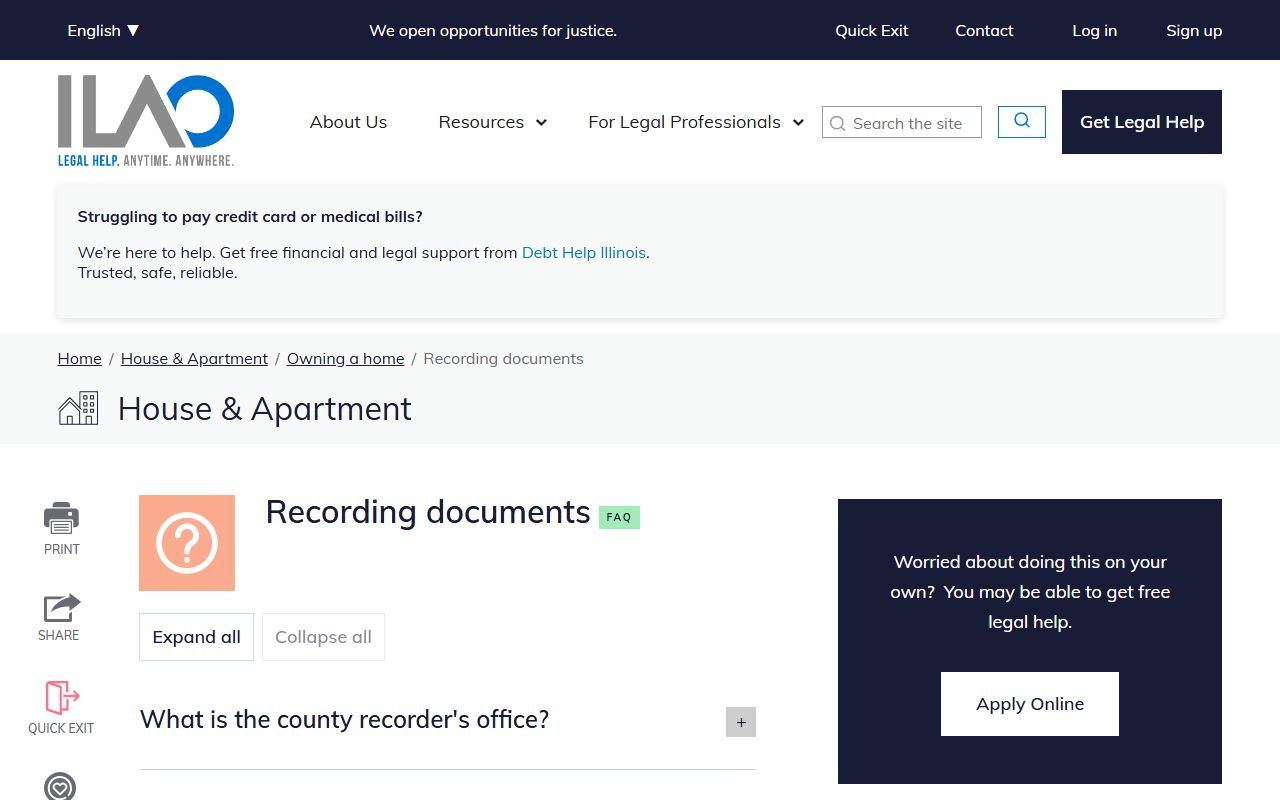
The Legal Aid resource walks through how to prepare a deed, what to bring to the Marion office, and what to do if the Recorder returns your document with a correction notice before it can be filed in Williamson County.
Tracing a full chain of title in Williamson County means following every deed transfer through the grantor and grantee indexes from the current owner back through each prior conveyance. The Marion office holds records going back many decades, all part of the same searchable public archive.
Nearby Counties
Property near a Williamson County line may have deed records held by an adjoining county's recorder. These counties border Williamson County in southern Illinois.